
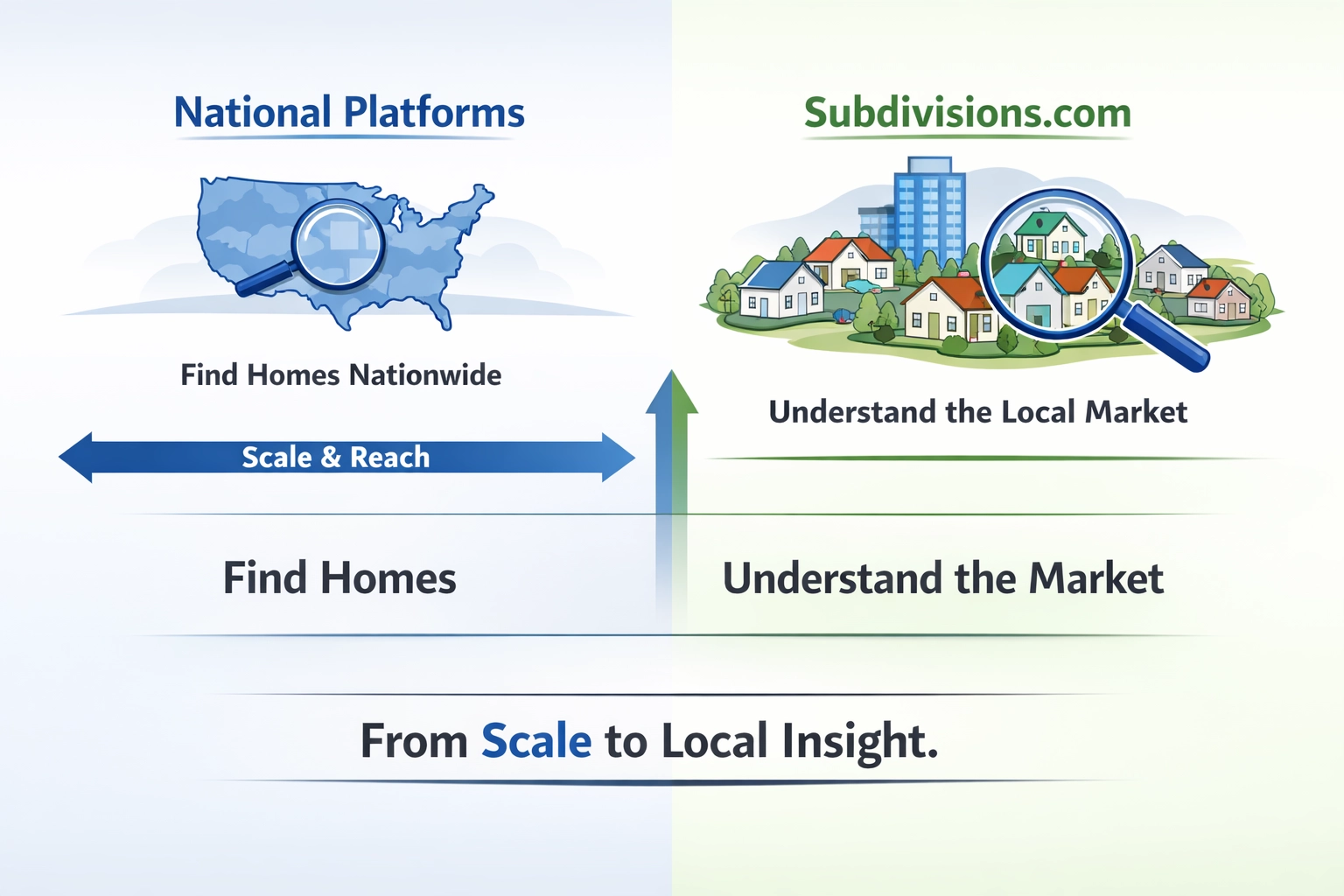

Real estate search has evolved dramatically over the past decade. Today, national property platforms allow users to browse listings across cities, states, and even the entire country with just a few clicks.
These platforms are designed to operate at a massive scale. Their strength lies in providing broad access to listings and making housing inventory easy to discover across many markets at once.
This scale has made real estate search faster and more convenient than ever.
But when it comes to understanding how real estate markets actually behave, scale alone does not always provide the full picture.
Real Estate Decisions Are Local
While national platforms cover the entire country, most real estate decisions happen at a much smaller level.
Buyers and sellers rarely think about the housing market in terms of national or even statewide trends. Instead, they focus on specific places that matter to them.
Often this means evaluating homes within:
specific communities
specific subdivisions
specific condo buildings
These smaller environments are where homes truly compete with one another.
For example, a property in one subdivision may primarily compete with homes in nearby communities with similar layouts, amenities, or price ranges—not with every property in the same city or ZIP code.
Understanding this local competitive landscape is essential for interpreting pricing and market activity.
The Difference Between Scale and Market Context
National real estate platforms excel at helping users find available homes.
Their systems are designed to organize listings across thousands of markets simultaneously, making it easy to search broadly and discover inventory.
However, understanding how a particular property fits into the local market context often requires looking more closely at the surrounding community.
Questions buyers and sellers frequently ask include:
How do homes in this subdivision compare to nearby communities?
What price range do properties in this building typically sell for?
How active is the inventory within this specific community?
These questions reflect the way people naturally evaluate real estate: by comparing properties within the communities where they actually compete.
Organizing Real Estate Around Micro-Markets
Subdivisions.com focuses on organizing real estate information around micro-markets, including subdivisions, communities, and condo buildings.
By structuring data at this level, the platform helps users explore insights such as:
price trends within a subdivision
active and sold inventory within a building
comparisons between competing communities
price differences between nearby subdivisions
This approach provides clearer context for how homes are positioned within their local market.
Understanding the Market Around the Home
Real estate search typically begins with finding properties.
But understanding the market around those properties can be just as important.
By organizing real estate data around communities and subdivisions, Subdivisions.com helps users better understand the competitive landscape that influences pricing and demand.
Key Takeaway
National platforms help people find homes.
Subdivisions.com helps people understand the market around those homes.

Comments