

The strongest angle is not “we built a more advanced valuation algorithm.”
That sounds technical, invites comparison with automated home-value tools, and reduces your work to a feature.
The stronger editorial position is:
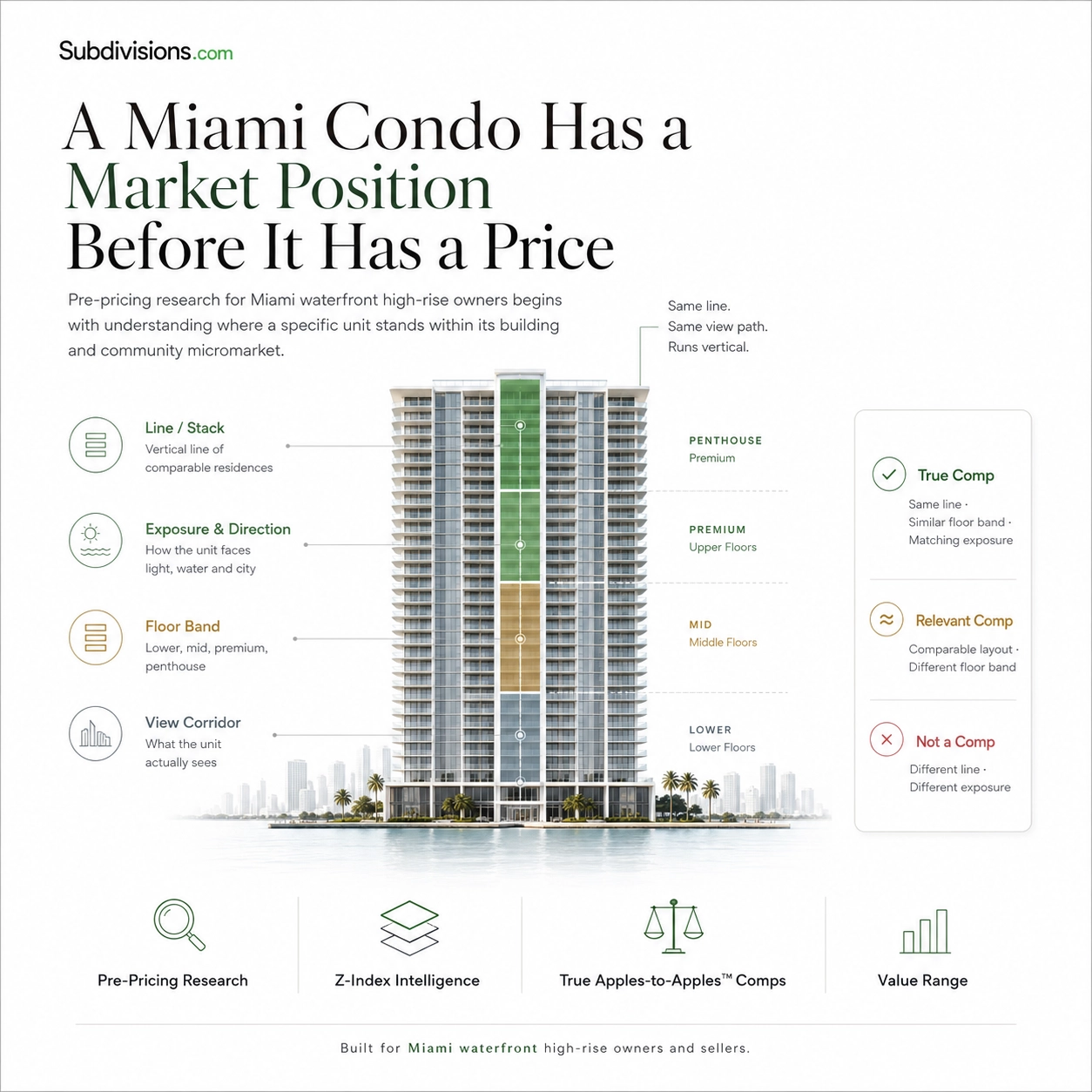
A Miami Condo Has a Market Position Before It Has a Price
This introduces a new way of thinking that homeowners immediately understand:
Their residence is not interchangeable with every unit in the tower.
Pricing should begin with unit positioning, not a generic estimate.
Subdivisions.com provides research before the owner makes a selling decision.
Best of Luxury Realty becomes the logical expert to translate that intelligence into a listing strategy.
I would also avoid an absolute “first ever” claim unless legally and independently validated. Use:
A first-of-its-kind approach built specifically for Miami waterfront high-rise owners.
That is strong, differentiated, and credible.
A Miami Condo Has a Market Position Before It Has a Price
Subdivisions.com introduces a first-of-its-kind pre-pricing research experience for Miami waterfront high-rise owners
Most homeowners begin with the same question:
What is my condo worth?
For a Miami waterfront residence, that may be the wrong place to start.
Before an owner chooses a price—or even decides whether to sell—there is a more important question:
How is my specific unit positioned within its building and community micromarket?
A condominium is not defined only by its bedroom count, interior square footage, or address.
It occupies a particular position within the tower.
Its line, floor, direction, exposure, view corridor, layout, condition, and relationship to current competition can all influence how buyers perceive it.
Two residences may appear nearly identical in a property database while delivering very different experiences in person.
And buyers often recognize those differences immediately.
Same tower. Different market position.
Consider two residences with the same floor plan and approximately the same interior area.
One faces southeast and receives morning light over the ocean.
The other faces west toward the skyline.
One clears a neighboring building.
The other has a partially obstructed view.
One is located in a preferred line with a wider terrace and more privacy.
The other is several floors higher but offers no meaningful improvement in exposure.
They may share an address.
They may even share the same bedroom count and floor plan.
But they are not necessarily competing for the same buyer—or deserving of the same pricing expectation.
That distinction is central to the way Miami’s waterfront high-rise market works.
The problem with conventional condo comparisons
Traditional pricing research often begins with broad filters:
same building;
similar square footage;
same bedroom count;
recent sale date;
price per square foot.
These criteria are useful, but they are only the beginning.
A sale does not become a strong comparable simply because it occurred in the same tower.
The more important question is:
What did that residence truly share with the subject unit?
A different line may create a different floor plan.
A different exposure may produce a different view and quality of light.
A different floor may clear an obstruction—or add little practical benefit.
A corner residence may offer more privacy and glass, while an interior residence may deliver a completely different living experience.
Without recognizing these distinctions, an owner can be shown a long list of sales that looks authoritative but provides weak pricing context.
More comps do not automatically create better intelligence.
Sometimes three highly relevant sales are more useful than twenty loosely related ones.
A new category: pre-pricing research
Subdivisions.com is being built around a different idea.
Owners should be able to understand their unit’s market position before they request a price opinion, interview an agent, or commit to listing.
We call this pre-pricing research.
It is the work that comes before the price.
It helps owners understand:
which residences truly belong in the comparison;
which sales appear similar but should be filtered out;
how their unit’s line and exposure affect its position;
whether floor height creates a meaningful advantage;
how their view compares with competing residences;
what buyers can currently choose instead;
how strong or limited the available evidence is.
This is not another instant home-value estimate.
It is a decision-support experience built around the realities of vertical residential living.
Understanding the individual unit
Subdivisions.com evaluates a residence within the context of its own building and community micromarket.
The analysis may consider:
condo tower or residential community;
unit line or stack;
floor and elevation;
direction;
exposure;
view relationship;
floor plan;
interior area;
relevant closed sales;
active competition;
current market conditions.
The objective is not to overwhelm the owner with data.
It is to identify the evidence that matters—and remove the comparisons that do not.
The owner should be able to see not only which residences were selected, but also why they were selected.
That transparency is essential.
A homeowner should never be asked to trust an unexplained number.
True Apples-to-Apples™ Comps
This approach forms the basis of True Apples-to-Apples™ Comps.
“True” does not mean that two residences are perfectly identical. In most high-rise buildings, no two sales will match in every respect.
It means the comparable set has been tested for meaningful relevance.
A strong comparable may share:
the same tower;
the same or closely related line;
a similar exposure;
a comparable view corridor;
a relevant floor band;
a similar layout and interior area;
appropriate market timing.
A residence on another side of the tower, with a different view and buyer experience, may be excluded even when it has the same number of bedrooms.
The purpose is not to find every sale.
It is to identify the sales most likely to shape how buyers perceive the subject residence.
Why exposure deserves greater attention
In Miami waterfront high-rises, exposure is not a decorative detail.
It influences daily experience.
Direction and exposure can affect:
natural light;
sunrise or sunset views;
heat and glare;
water visibility;
skyline visibility;
privacy;
balcony use;
view durability;
buyer preference.
An east-facing residence may offer cooler mornings and direct ocean light.
A west-facing unit may provide dramatic sunsets over the city or intracoastal.
A higher floor may command more only when it improves the view, privacy, or overall experience.
These distinctions are difficult to capture through broad building averages.
That is why Subdivisions.com examines where the unit is positioned—not simply how large it is.
From relevant evidence to a Value Range
No individual sale can establish the precise value of another residence.
Even the strongest comparable will differ in condition, timing, finishes, negotiation, or buyer motivation.
For that reason, Subdivisions.com organizes the most relevant available evidence into a True Apples-to-Apples™ Value Range.
The Value Range is intended to provide orientation, not false certainty.
It helps the owner understand:
where the residence may be positioned;
which sales create the strongest support;
what may justify the upper portion of the range;
what may pull the unit toward the lower portion;
how current competition affects strategy;
where professional review remains necessary.
The Value Range does not replace a listing strategy.
It creates a more informed foundation for one.
Closed evidence and current competition are not the same
A useful condo analysis must distinguish between what buyers have already paid and what buyers can choose today.
Closed True Comps
These provide evidence of completed market decisions.
Active Competition
These show the alternatives currently competing for buyer attention.
An active listing is not proof of value because its asking price has not yet been accepted by the market.
But it can materially affect how a new listing should be positioned.
A residence may be strongly supported by historical sales and still face difficult competition from a newly renovated unit with a superior view.
Both forms of evidence matter—but they should not be mixed together.
Research before the selling decision
Not every homeowner researching their residence is ready to list.
Some are considering a move within the next year.
Some are evaluating whether renovations would be worthwhile.
Some are watching how their line performs.
Others simply want to understand whether their expectations are supported by the market.
That is why pre-pricing research is also pre-decision research.
It can help an owner explore questions such as:
Is my unit meaningfully different from the last sale in the building?
Are buyers paying more for my exposure?
Does my floor clear an important obstruction?
Which current listing is my closest competitor?
Is there enough recent evidence to support a confident range?
Would waiting for another sale materially improve the analysis?
Does the market support the price I have in mind?
These questions should be answered before the owner is pressured to make a listing decision.
Technology identifies the evidence. Expertise completes the strategy.
Data can identify patterns, organize sales, compare unit characteristics, and reveal competitive positioning.
But data cannot fully evaluate every aspect of a residence.
A complete listing strategy may still require direct review of:
interior condition;
renovation quality;
special assessments;
furnishings;
presentation;
seller timing;
building-specific buyer behavior;
launch strategy;
negotiation priorities.
This is where Best of Luxury Realty enters the process.
Subdivisions.com provides the unit-level market intelligence.
Best of Luxury Realty applies local expertise to turn that intelligence into a practical pricing and listing strategy.
The relationship is intentionally clear:
Market intelligence by Subdivisions.com.
Listing strategy and representation by Best of Luxury Realty.
The homeowner begins with useful research—not a sales pitch.
When the owner is ready, the advisor continues from the same evidence rather than beginning with a generic presentation.
A better starting point for Miami condo owners
The traditional process begins with a number.
The better process begins with understanding.
Before selecting a listing price, a Miami waterfront condo owner should know:
where the unit stands within the tower;
which residences truly compare with it;
what makes it more or less desirable;
how current buyers are likely to evaluate it;
which competing listings may influence the outcome;
how strong the available evidence actually is.
A condo does not enter the market as a collection of bedrooms and square feet.
It enters as a specific residence with a specific position.
Understanding that position is the first step toward stronger pricing, clearer expectations, and a more informed decision.
Know Your Unit’s Position Before You List
Subdivisions.com helps Miami waterfront high-rise owners identify the residences that truly compare with theirs and understand the evidence behind their True Apples-to-Apples™ Value Range.
When you are ready to explore a sale, a Best of Luxury Realty waterfront condo advisor can review your residence, current competition, pricing options, and likely net proceeds.

Comments