
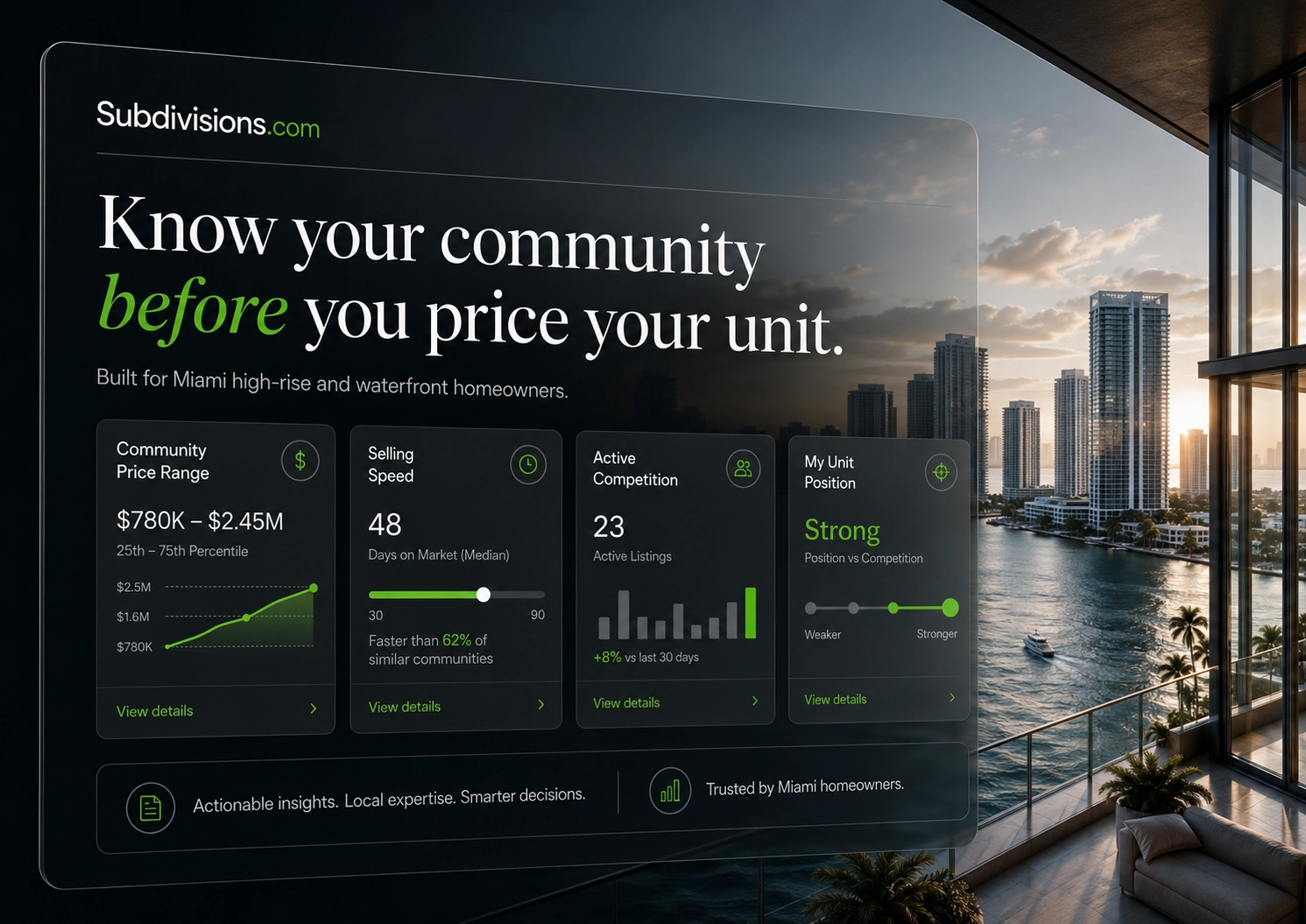

Before You Sell a Miami Condo, Understand the Market It Belongs To
For many Miami homeowners, the first question before selling is simple:
What is my condo worth?
But in a high-rise market, that question is rarely answered well by looking at the building address alone.
Two units in the same tower may compete in very different ways. Floor height, line, view, exposure, layout, condition, renovation quality, monthly fees, assessments, and building rules can all influence how buyers respond. A unit facing open water may not belong in the same comparison set as a lower-floor residence facing another building, even when both have the same bedroom count and square footage.
That is why Subdivisions.com is being developed as a web app for homeowners and sellers who want more useful context before making a real estate decision.
Our initial focus is Miami, including high-rise condos, waterfront communities, and residential buildings where broad city averages often fail to explain what is happening at the property level.
Search tells you what is listed. Context tells you what it means.
Most real estate websites are designed around property search.
They are useful for seeing what is available, browsing photos, and comparing asking prices. But homeowners preparing to sell need a different kind of experience.
They need to understand:
how quickly homes are selling in their market;
how much active competition exists;
whether inventory is rising or tightening;
how their residential community is performing;
which closed sales are genuinely comparable;
where their unit may sit within the current market.
Subdivisions.com is being built around that decision process.
Instead of treating every nearby property as equally relevant, the platform begins with the residential community the property belongs to. In Miami, that community may be a waterfront condo tower, a multi-building complex, a gated residential development, or another clearly defined housing market.
The goal is not to produce another broad automated number. It is to help homeowners understand the market around their property before they price, list, or make a major decision.
Why Miami high-rise condos require more precision
High-rise condo markets make the limits of broad valuation especially visible.
A single tower can contain several distinct buyer segments. The most relevant comparison may depend on:
the unit line;
floor range;
direct, partial, or obstructed water views;
corner versus interior positioning;
residence size and configuration;
renovation level;
balcony exposure;
monthly association costs;
current or proposed assessments;
rental and pet restrictions;
the amount of competing inventory in the building.
Physical distance is still useful, but it does not always define the true market.
In many cases, a buyer considering a waterfront condo in Sunny Isles Beach, Brickell, Miami Beach, or Aventura is not simply comparing every property within a one-mile radius. The buyer may be comparing a specific group of towers, unit types, views, and price levels.
That distinction matters.
Distance measures space. Market definition measures competition.
A complimentary starting point for homeowners
Subdivisions.com is designed to give homeowners a practical place to begin without requiring an immediate purchase.
A homeowner may receive one complimentary limited residential community snapshot, including a community price range and selected market signals.
Depending on available data, the snapshot may help the homeowner review:
recent selling speed;
market supply;
sales activity;
the general price range within the residential community.
This is intended as an orientation tool, not a unit-specific appraisal or a substitute for professional advice.
A community price range can help answer an important first question:
What kind of market does my property belong to?
It does not, by itself, determine where a particular residence should be positioned within that range.
Going deeper with True Apples-to-Apples™ analysis
Homeowners who want unit-level evidence can choose a paid True Apples-to-Apples™ analysis.
The purpose is to move beyond broad community context and identify the properties that are more likely to represent the same competitive market as the subject unit.
The paid experience is being developed to include deeper elements such as:
true closed comparable sales;
active competition;
unit-level market positioning;
a supported value range;
community and unit context in one place.
Some of these capabilities are still being implemented and refined. We believe it is more useful to be clear about what the platform does today and what is being developed than to present every planned feature as already available.
The methodology, property identity systems, community structure, and comparable-market logic behind the product have been built and improved over several years. Paid access helps support continued data maintenance, product development, quality controls, and a fair path to monetization.
The objective is not to charge homeowners for information they can easily find elsewhere. It is to provide a more organized and relevant layer of market intelligence that is difficult to assemble manually.
Not every closed sale is a true comparable
A property can be close in distance and still be a weak comparable.
A true comparable should reflect how buyers are likely to evaluate the subject property. In a Miami waterfront condo tower, that may require looking beyond the basic facts shown in a listing record.
For example, two units may both be described as:
two bedrooms;
two bathrooms;
approximately 1,500 square feet;
located in the same building.
But one may have a direct ocean view from a high floor, while the other has a lower-floor city exposure. One may be fully renovated, while the other requires substantial work. One may belong to a more desirable line with stronger natural light and a larger balcony.
Those differences may meaningfully affect buyer behavior.
True Apples-to-Apples™ is intended to make the comparison process narrower and more defensible—not simply larger.
More comparable records do not always produce a better answer. Sometimes the value comes from knowing which records should not be included.
Understanding active competition
Closed sales show what buyers previously accepted.
Active listings show what a seller must compete against now.
Both matter, but they answer different questions.
A homeowner preparing to sell should understand:
which units have recently closed;
how long they took to sell;
whether sellers reduced their asking prices;
which comparable units are currently available;
how the subject unit may compare on view, floor, condition, and price;
whether the market is moving toward buyers or sellers.
A unit may appear well positioned against older closed sales but still face strong competition from several newly listed residences in the same building.
That is why Subdivisions.com separates closed evidence from active competition rather than blending everything into one number.
Designed for homeowners before they are ready to list
Many homeowners begin researching months before they contact an agent.
They may be considering a move, reviewing their equity, comparing buildings, preparing for retirement, evaluating a renovation, or simply trying to understand whether the market has changed.
The platform is intended to serve that earlier stage.
A homeowner should be able to return and quickly review:
the city market;
the residential community;
the property or unit;
relevant market changes;
saved preferences and goals.
Personalization features are also being developed so returning users can see the markets and properties most relevant to them first.
These features are designed to support the homeowner’s decision process, not replace professional judgment. When a homeowner is ready to sell, an experienced local advisor can add important context involving condition, showing feedback, pricing strategy, building-specific issues, negotiations, and legal responsibilities.
A more transparent path to pricing
Pricing a home is not about finding the highest possible number.
It is about finding a position that the current market can support.
Price too high, and the listing may lose momentum, accumulate market time, and require repeated reductions. Price too low, and the homeowner may give up value unnecessarily.
A more informed process begins by defining:
the residential community;
the relevant unit segment;
the true closed comparables;
the active competition;
the current balance of supply and demand.
Only then does a value range become meaningful.
This is the principle behind the platform:
Before a property can be valued, its market must be defined.
Built carefully, not presented as finished
Subdivisions.com has been under development for several years, but we do not consider the product complete.
Some capabilities are available now. Others are being tested, expanded, or prepared for implementation.
Our focus is to improve the experience responsibly, beginning with the Miami homeowner and seller use case where the need is especially visible: high-rise condos, waterfront properties, and residential communities with meaningful internal differences.
We are working toward a web app that helps homeowners:
orient themselves before selling;
understand their residential community;
compare their property more intelligently;
review true apples-to-apples evidence;
make a more informed pricing decision.
The goal is not to replace agents, appraisers, attorneys, or other professionals.
The goal is to give the homeowner a better starting point.
Know where your condo stands before you sell
Selling a Miami condo is a major financial decision.
Homeowners deserve more than a broad city statistic, an unexplained automated number, or a collection of nearby listings that may not belong in the comparison.
Subdivisions.com is being built to provide a clearer progression:
Understand the city.
Understand the residential community.
Understand the unit.
Then decide.
Homeowners can begin with a complimentary limited community snapshot and community price range. Those who want deeper, unit-specific evidence can explore the paid True Apples-to-Apples™ analysis.
View True Apples-to-Apples™ pricing and access options

Comments