

In Florida condo living, location gets most of the attention.
Buyers compare buildings, neighborhoods, amenities, floor levels, views, and price per square foot. Those details matter. But in waterfront and high-rise markets, one factor can dramatically change how a residence feels, lives, photographs, rents, and resells:
Exposure.
Exposure is the direction a residence faces, but its impact goes far beyond a compass point. It shapes the light, view, heat, privacy, balcony comfort, and emotional experience of the home.
Two condos can be in the same building, on similar floors, with nearly identical floor plans. One may feel bright, open, private, and connected to the water. The other may feel darker, hotter, more exposed, or less memorable.
That difference often comes down to exposure.
Location Tells You Where It Is. Exposure Tells You How It Lives.
A map can show where a building sits. It cannot show how a specific residence feels at sunrise, midday, late afternoon, or sunset.
That is where exposure becomes important.
It affects:
Morning light
Afternoon heat
Ocean, Intracoastal, bay, city, or sunset views
Balcony usability
Interior brightness
Glare
Privacy
Photography appeal
Rental appeal
Resale desirability
In vertical living, buyers are not just purchasing square footage. They are purchasing a daily experience.
On Florida’s Atlantic Coast, East Exposure Often Leads
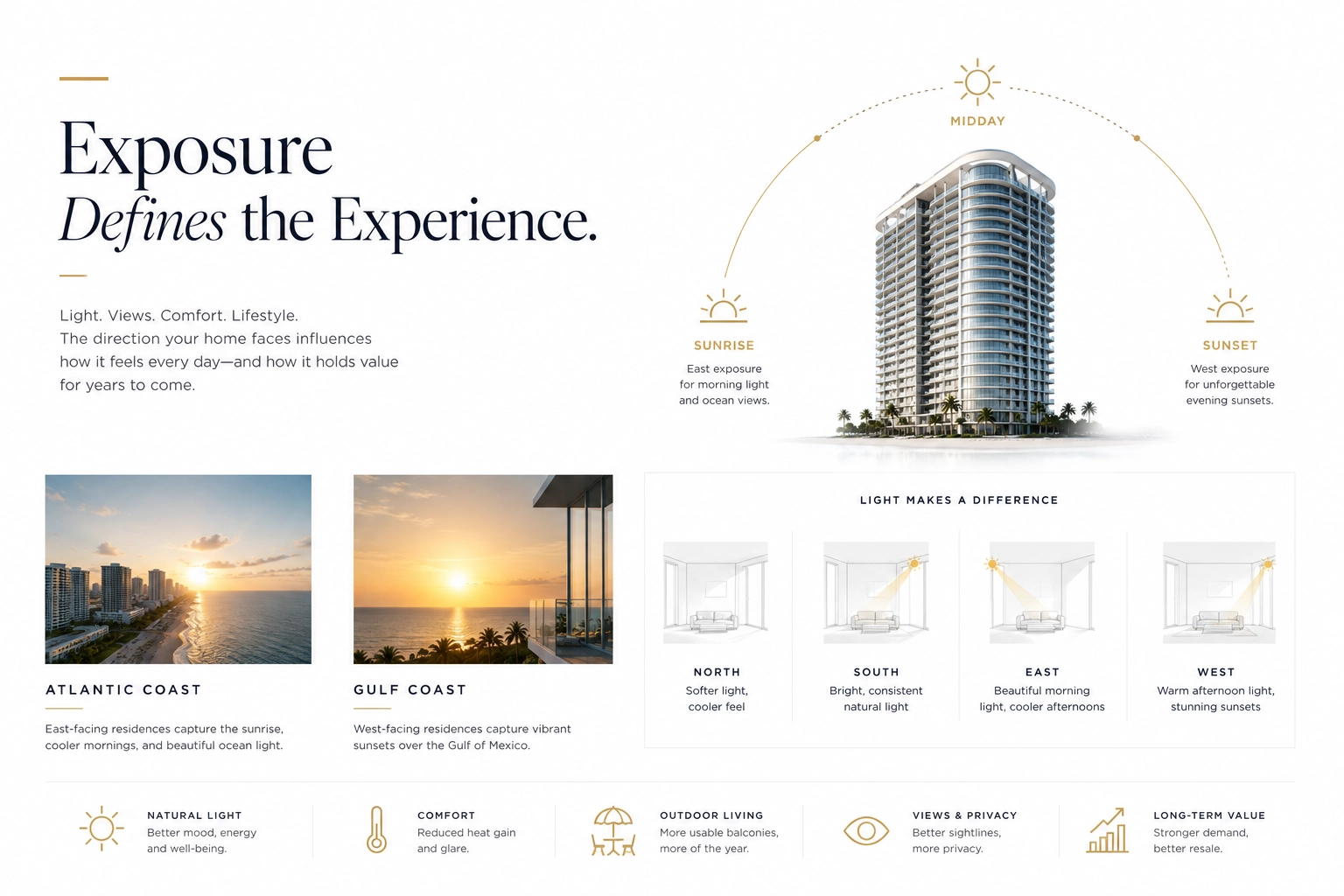
On Florida’s Atlantic Coast — including Miami Beach, Sunny Isles Beach, Bal Harbour, Surfside, Fort Lauderdale, Boca Raton, and Palm Beach — east-facing residences often carry strong lifestyle appeal, especially in beachfront and ocean-view buildings.
The reason is simple: east-facing units capture the sunrise over the Atlantic Ocean.
They often offer morning light, direct ocean orientation, and a cooler late-day living experience compared with units exposed to stronger afternoon sun.
For many beachfront buyers, the sunrise is not just scenery. It is part of the lifestyle.
But east exposure is not automatically superior. A lower east-facing unit with an obstructed view may be less desirable than a higher southeast or northeast corner residence with open water views, better privacy, and stronger natural light.
The smartest buyers do not only ask, “Which direction does it face?”
They ask, “How does this specific residence actually live?”
South Exposure Can Be the Light Advantage
In Florida, south-facing residences often provide stronger and more consistent daylight than north-facing residences.
That can make a meaningful difference in how a condo feels.
A south-facing unit may feel brighter, warmer, and more open throughout the day. A north-facing unit may offer softer light and cooler interiors, but it can also feel more shaded depending on the season, building design, and surrounding towers.
Neither direction is universally better. The right exposure depends on the buyer’s priorities.
Some buyers want maximum light. Others want reduced glare. Some want cooler rooms. Others want the most dramatic view.
Exposure is not a one-size-fits-all rule. It is a lifestyle match.
On Florida’s Gulf Coast, West Exposure Often Wins
On Florida’s Gulf Coast — including Naples, Marco Island, Bonita Springs, Fort Myers Beach, Sarasota, Longboat Key, Clearwater Beach, and St. Pete Beach — west-facing residences often carry strong lifestyle appeal because they capture sunset views over the Gulf of Mexico.
For Gulf-front buyers, sunset is not a small feature. It is a daily event.
A west-facing balcony can become the emotional center of the home — the place where owners gather, relax, entertain, and watch the sky change over the water.
That emotional value can strongly influence buyer demand.
But west exposure also requires careful evaluation. Afternoon sun can create heat and glare, especially in residences with large glass walls or shallow balconies. Glass quality, balcony depth, overhangs, shading, and building orientation all matter.
A beautiful sunset view is powerful. But the best properties combine the view with comfort.
Exposure Is More Than a View
Many buyers think exposure only means what you see.
That is too narrow.
Exposure affects how a property performs and feels every day. It can influence natural light, temperature, privacy, balcony use, photography, rental appeal, and resale positioning.
A great exposure may create:
Better natural light
More usable outdoor space
Stronger photography
Greater emotional appeal
More comfortable interiors
Better perceived value
Stronger resale positioning
This is why exposure should be evaluated as part of the property’s real identity, not treated like a minor listing detail.
The Smart Buyer’s Exposure Checklist
Before buying a Florida condo, ask:
Which direction does the residence face?
Is the view open, partial, or obstructed?
Does it receive morning, midday, or afternoon sun?
Is the balcony comfortable during the hottest part of the day?
Does the glass help control heat and glare?
Is the residence bright without being uncomfortable?
Does the exposure provide privacy from nearby towers?
Is the view likely to remain protected?
How does this line compare with others in the same building?
Will this exposure help or hurt resale appeal?
These questions help buyers move beyond attractive listing photos and understand the property more intelligently.
The Bottom Line
In Florida vertical living, the best condo is not always the largest, newest, or highest.
It is often the one that lives the best.
On the Atlantic Coast, east exposure often delivers the sunrise, ocean view, and morning-light lifestyle many beachfront buyers want.
On the Gulf Coast, west exposure often delivers the sunset experience that defines waterfront living in Naples, Marco Island, Sarasota, Longboat Key, Fort Myers Beach, Clearwater Beach, and St. Pete Beach.
South exposure can offer stronger daylight. North exposure can offer softer light and cooler interiors. Corner units can outperform single-direction units when they combine views, light, privacy, and openness.
The key is context.
Exposure should always be evaluated alongside floor height, view obstruction, balcony depth, glass quality, building design, and local buyer demand.
Location tells you where the property is. Exposure tells you what it feels like to live there.

Comments