

Most pricing mistakes in residential real estate do not start with the final number.
They start earlier.
They start with the wrong market definition.
That is the part the industry still underestimates.
A property can be close on a map and still be the wrong comp. A nearby sale can look similar on paper and still belong to a different buyer pool. A home across the street can have the same square footage, same bedroom count, and same build year — but compete inside a completely different market because of subdivision identity, school boundaries, amenities, construction profile, lifestyle expectations, or pricing behavior.
In residential real estate, nearby does not always mean comparable.
And when the wrong market is used, every decision built on top of it becomes weaker.
The Problem Is Not Lack of Listings
The industry does not have a listing shortage.
Buyers, sellers, agents, appraisers, investors, lenders, and analysts are surrounded by property data. There are listings, sold records, tax records, photos, public records, price histories, market reports, portal estimates, and automated valuation tools.
The problem is not access to data.
The problem is structure.
Most real estate search still organizes properties around broad geography:
City.
ZIP code.
Radius.
Nearby listings.
Those are useful starting points, but they are not always how residential markets actually work.
A city is too broad.
A ZIP code is often too mixed.
A radius can cross into unrelated markets.
The real competitive environment is often much more specific.
It may be the subdivision.
The condo building.
The gated community.
The master-planned community.
The immediate neighborhood.
The school cluster.
The group of communities where buyers are actually cross-shopping.
That is the property’s native market.
And the native market is where the pricing story becomes real.
A Radius Does Not Understand the Market
A radius search is easy.
Draw a circle around a property. Pull nearby listings. Pull recent sales. Calculate a number.
That workflow feels objective because it is simple and visible.
But a radius does not understand buyer behavior.
It does not know which communities buyers actually compare.
It does not know when a subdivision across the road appeals to a different buyer pool.
It does not know when a nearby property belongs to a different school boundary, different amenity package, different HOA environment, different construction period, different lifestyle profile, or different value tier.
That creates comp noise.
And comp noise distorts decisions.
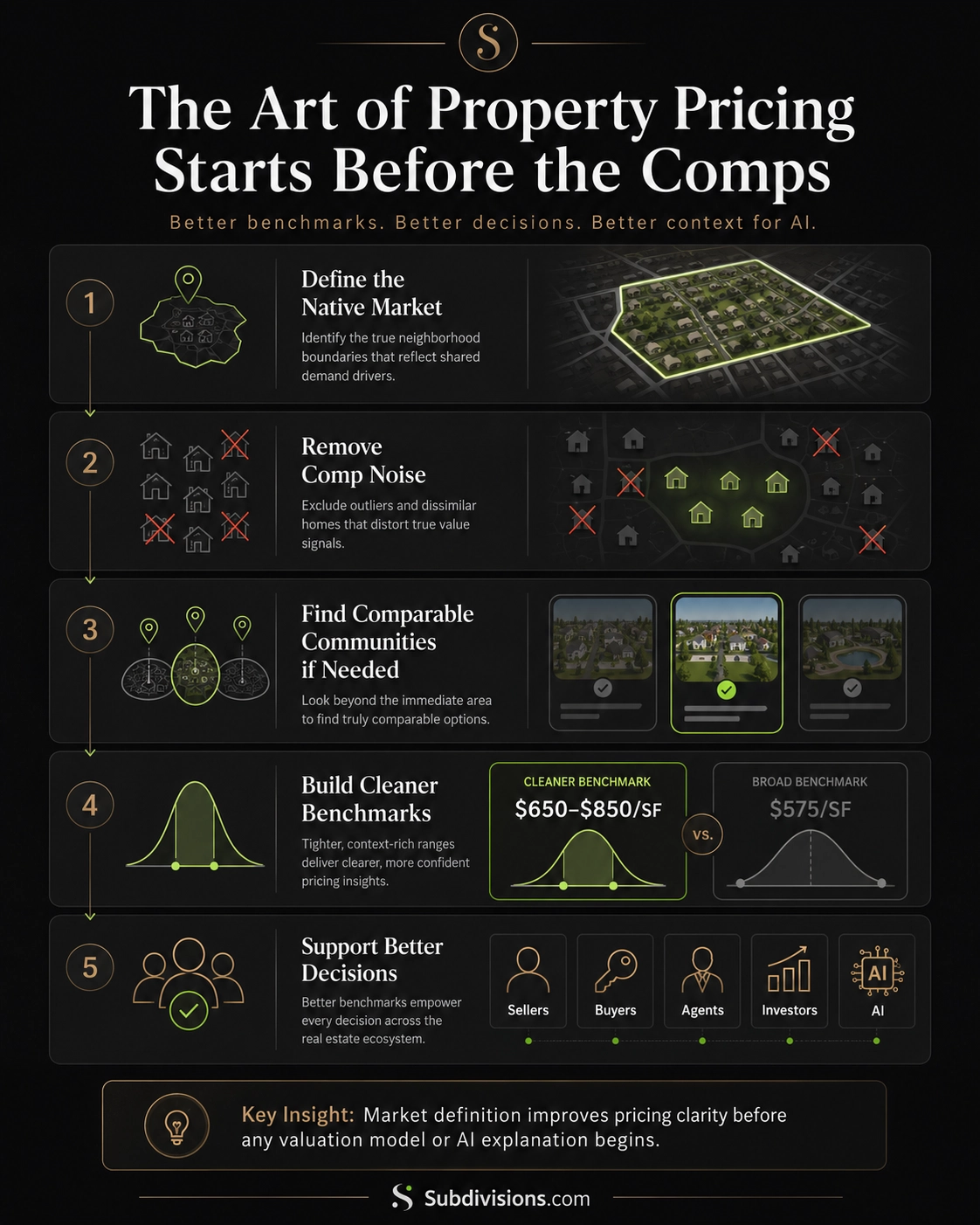
For example, a broad distance-based comp pull may show an average around $575 per square foot because it includes nearby but unrelated properties.
But inside the property’s true native market, the relevant pricing range may be closer to $650–$850 per square foot.
That is not a small difference.
That difference can change a seller’s pricing strategy.
It can change a buyer’s perception of value.
It can change an investor’s return assumptions.
It can change an agent’s CMA.
It can change the confidence behind an AI-generated explanation.
When unrelated comps enter the set, the benchmark becomes less useful.
The math may still be correct.
The market definition may not be.
The Art of Pricing Is Knowing What to Exclude
Good pricing is not just about finding comps.
It is about knowing which properties should not be included.
Experienced real estate professionals understand this. They do not simply pull everything nearby and call it a comp. They rebuild the market first.
They ask:
Where does this property actually compete?
Which community does it belong to?
Which nearby homes are real alternatives?
Which homes only look comparable because they are close on a map?
Where is the price ceiling inside this specific buyer pool?
Which properties would buyers realistically consider before making an offer?
That is the art of property pricing.
It is not just calculation.
It is market judgment.
And the first step in that judgment is defining the native market.
Only after the market is defined correctly can the comp set become meaningful.
The Next Challenge: What Happens When the Native Market Is Thin?
There is another important reality in property pricing.
Sometimes the native market is clear, but the available comp pool is thin.
A subdivision, condo building, or residential community may not have enough recent sales to fully support a pricing analysis by itself. In appraisal and lending workflows, multiple comparable sales are generally expected in the sales comparison approach. That creates a second challenge.
If there are not enough recent sales inside the subject community, the professional may need to look outside the immediate native market.
But outside does not mean random.
And close does not automatically mean comparable.
A city can contain hundreds of subdivisions, condo buildings, and residential communities. The nearest community may not be the best alternative. It may have a different buyer profile, different construction period, different building size, different amenity profile, different waterfront exposure, different school pattern, different pricing tier, or different inventory behavior.
That is why the next layer is community comparability.
Once the native market is identified, the next question becomes:
If the comp pool is thin, which other communities are actually comparable?
That question cannot be answered with beds, baths, and square footage alone.
A 2-bedroom / 2-bath match is not enough.
Community comparability may depend on:
Building size.
Construction year.
Community type.
Amenity profile.
Price tier.
Buyer profile.
Location pattern.
Waterfront, golf, or lifestyle exposure.
School cluster.
Inventory behavior.
Recent sales depth.
Price-per-square-foot range.
Lifestyle similarity.
Cross-shopping behavior.
This is where local expertise has traditionally mattered.
A strong local agent, appraiser, or analyst often knows which communities are truly comparable because they have spent years inside the market. They have visited the buildings. They know which subdivisions buyers cross-shop. They understand which communities feel similar, which ones command a premium, and which ones only look comparable from a distance.
Until now, much of that knowledge has been difficult to structure.
It often lived in the heads of local experts.
Subdivisions.com is working to make more of that community-comparability knowledge structured, searchable, and explainable through data.
The goal is not to replace professional judgment.
The goal is to support it with better market structure.
If a buyer likes one community, they often ask:
“What else is similar in the same price category?”
That is a very different question from:
“What else is nearby?”
Traditional property search does not answer that well.
Better market intelligence should help identify the subject community first, then identify the best comparable communities when the immediate comp pool is too thin.
That is how the industry can move from distance-based search to market-based comparison.
Why This Took So Long to Solve
This problem has existed for a long time, but it did not persist because professionals failed to notice it.
Professionals noticed it every day.
Agents noticed it when they had to clean up weak comps before a listing appointment.
Appraisers noticed it when nearby sales did not truly reflect the subject property’s market.
Developers noticed it when evaluating competing supply.
Investors noticed it when a property looked cheap based on broad averages but was not actually cheap inside its true market.
The problem persisted because the industry digitized listings before it structured the markets those listings belong to.
MLS data is mostly property-first.
Public records are parcel-first.
Portals are search-first.
Valuation tools are often proximity-first.
But residential decision-making is often community-first.
That mismatch is the gap.
Subdivisions, condo buildings, master-planned communities, and named residential communities are not always treated as structured market entities. They are often treated as labels, remarks, map areas, or loose neighborhood references.
That makes it difficult to build reliable benchmarks around them.
So the industry defaulted to what was easier to scale:
City.
ZIP code.
Radius.
Nearby listings.
Those methods are useful.
But they are not enough.
Easier to scale does not always mean closer to the real market.
What Subdivisions.com Is Building
Subdivisions.com is built around a simple belief:
Residential real estate decisions are often made at the community level.
People do not just buy bedrooms, bathrooms, and square footage.
They buy into subdivisions, buildings, residential communities, lifestyle patterns, amenities, school clusters, price tiers, and local market expectations.
That is why Subdivisions.com treats communities as structured market entities, not just map labels.
A subdivision or residential community can carry meaningful market context:
Active competition.
Recent sales.
Price-per-square-foot ranges.
Value tiers.
Market movement.
Inventory pressure.
Comparable communities.
Resident interest.
Seller competition.
Buyer demand signals.
Extracted listing signals where available.
HOA and community context indicators where available.
This turns scattered listing data into decision-ready market intelligence.
The goal is not to maintain every community document or claim official rule coverage.
That is not realistic at scale.
The goal is to structure available listing, property, transaction, and market signals in a more meaningful way.
The goal is to help users move from scattered data to better context.
Instead of asking only:
“What sold nearby?”
The better question is:
“What actually belongs in the same market?”
And when the immediate market is thin:
“Which other communities are truly comparable?”
Better Benchmarks Create Better Decisions
A better benchmark is not just a better number.
It is a better decision framework.
For sellers, better benchmarks help identify real competition. A seller does not need to compare against every listing in the city. They need to understand how their property is positioned inside the market where buyers will actually compare it.
For buyers, better benchmarks help separate real value from misleading averages. A property may look expensive against a broad ZIP-code average but fair inside its true native market. Another property may look like a bargain until the correct community benchmark shows it is priced exactly where it should be.
For agents, better benchmarks reduce manual market reconstruction. Instead of starting every CMA from a noisy search result, agents can begin with cleaner community context and spend more time advising rather than cleaning data.
For investors, better benchmarks improve opportunity screening. A discount only matters if it is measured against the right market. Broad averages can create false bargains. Native-market benchmarks can help reveal whether the opportunity is real.
For residents, better benchmarks create visibility into their own community. Many homeowners are not searching the entire city. They want to know what is happening inside the subdivision, condo complex, or building where they already live.
For lenders and risk teams, better market context can support a more informed view of collateral. It does not replace appraisal or underwriting, but it can improve the quality of the local market picture surrounding a property.
What Can Be Measured
The value of better market definition can be measured.
Not by claiming that every valuation becomes automatic.
Not by pretending that data replaces professional judgment.
But by measuring whether the decision environment improves.
Useful metrics include:
Comp-set precision: how many properties from a broad radius search are removed because they do not belong to the native market.
Pricing range clarity: whether the price-per-square-foot range becomes tighter after unrelated comps are excluded.
Outlier detection: whether a property is priced above or below the range supported by its true competitive set.
CMA preparation efficiency: how much manual cleanup can be reduced when the market is structured correctly from the beginning.
Seller competition quality: whether active listings are compared inside the correct community context.
Buyer comparison quality: whether buyers are reviewing properties that truly compete with each other.
Comparable-community quality: whether alternative communities are selected based on meaningful similarity rather than distance alone.
Investor screening quality: whether return assumptions are based on the correct market benchmark.
AI explanation quality: whether AI-generated answers are built on cleaner market context instead of broad, noisy data.
That is where the value is.
Less noise.
Cleaner benchmarks.
Better context.
Stronger explanations.
Better decisions.
Why This Matters for AI
AI will not fix weak market definition by itself.
In fact, it can make the problem worse.
If AI is given scattered listing data, broad geography, and weak comp logic, it may produce an answer that sounds confident but is built on the wrong market.
That is dangerous.
A language model can summarize listings. It can compare prices. It can explain trends. It can answer questions in a polished way.
But if the underlying market context is wrong, the explanation may simply make the wrong answer sound more convincing.
The future of AI in residential real estate will not be driven only by better models.
It will depend on better data infrastructure.
AI needs to understand the difference between:
Nearby properties and true comps.
City averages and community benchmarks.
Broad inventory and real competition.
Listing attributes and market context.
A property’s location and its native market.
The subject community and comparable communities.
Without that structure, AI can describe the market but still miss the market.
With better structure, AI becomes more useful. It can help explain why a property belongs in a comp set, why another should be excluded, where a price sits within its native market, and which comparable communities may be relevant when the immediate comp pool is thin.
That is the foundation for better real estate intelligence.
From Property Search to Market Intelligence
Traditional property search starts with listing attributes.
Location.
Price.
Beds.
Baths.
Size.
That is useful for finding inventory.
But pricing decisions require more than inventory.
They require context.
The next evolution of residential real estate search is not simply faster search or more filters.
It is better market structure.
A better model starts with:
Community identity.
Native market.
Comparable communities.
True competitive set.
Value tier.
Active competition.
Recent sales.
Price-per-square-foot benchmarks.
Market movement.
Buyer behavior.
Decision context.
That is how search becomes intelligence.
And that is how pricing becomes more useful.
The Subdivisions.com Point of View
At Subdivisions.com, our view is simple:
Better property pricing does not start with more data.
It starts with better market definition.
Before you can judge a property, you have to understand where it actually competes.
And when the immediate comp pool is thin, you have to understand which other communities are truly comparable.
That means organizing residential real estate around the community-level markets where decisions are made — not only around city, ZIP code, radius, or scattered listing attributes.
This is not about replacing agents, appraisers, analysts, lenders, or investors.
It is about supporting better decisions with better benchmarks.
It is about reducing the noise before the pricing conversation begins.
It is about helping users understand the market behind the number.
Because in residential real estate, the better question is not simply:
“What is nearby?”
The better question is:
“What actually belongs in the same market?”
And sometimes:
“What other community is truly comparable?”
Final Thought
The art of property pricing starts before the comps.
It starts with defining the market.
A broad average can tell part of the story. A radius can show what is close. A listing feed can show what is available.
But the real pricing signal often lives inside the subdivision, building, or residential community where the property actually competes.
And when that community does not provide enough recent sales, the next best answer is not a bigger radius.
It is a better understanding of comparable communities.
That is where true benchmarks are formed.
That is where buyers compare.
That is where sellers compete.
That is where investors identify real opportunity.
And that is where AI needs better context.
Better market definition creates better benchmarks.
Better benchmarks create better decisions.
And better context is what will make AI in real estate truly useful.

Comments