

Most condo owners in South Florida understand the basics of real estate pricing.
You’ve probably watched sales in your building.
You know which units sold recently.
You may even know what price per square foot buyers are paying.
But even in buildings where owners follow the market closely, pricing patterns can still feel unpredictable.
Why did a unit two floors above yours sell for more?
Why did a seemingly comparable unit sit on the market longer?
Why does price per square foot vary across the same building?
The answer often comes down to something many real estate platforms fail to represent clearly:
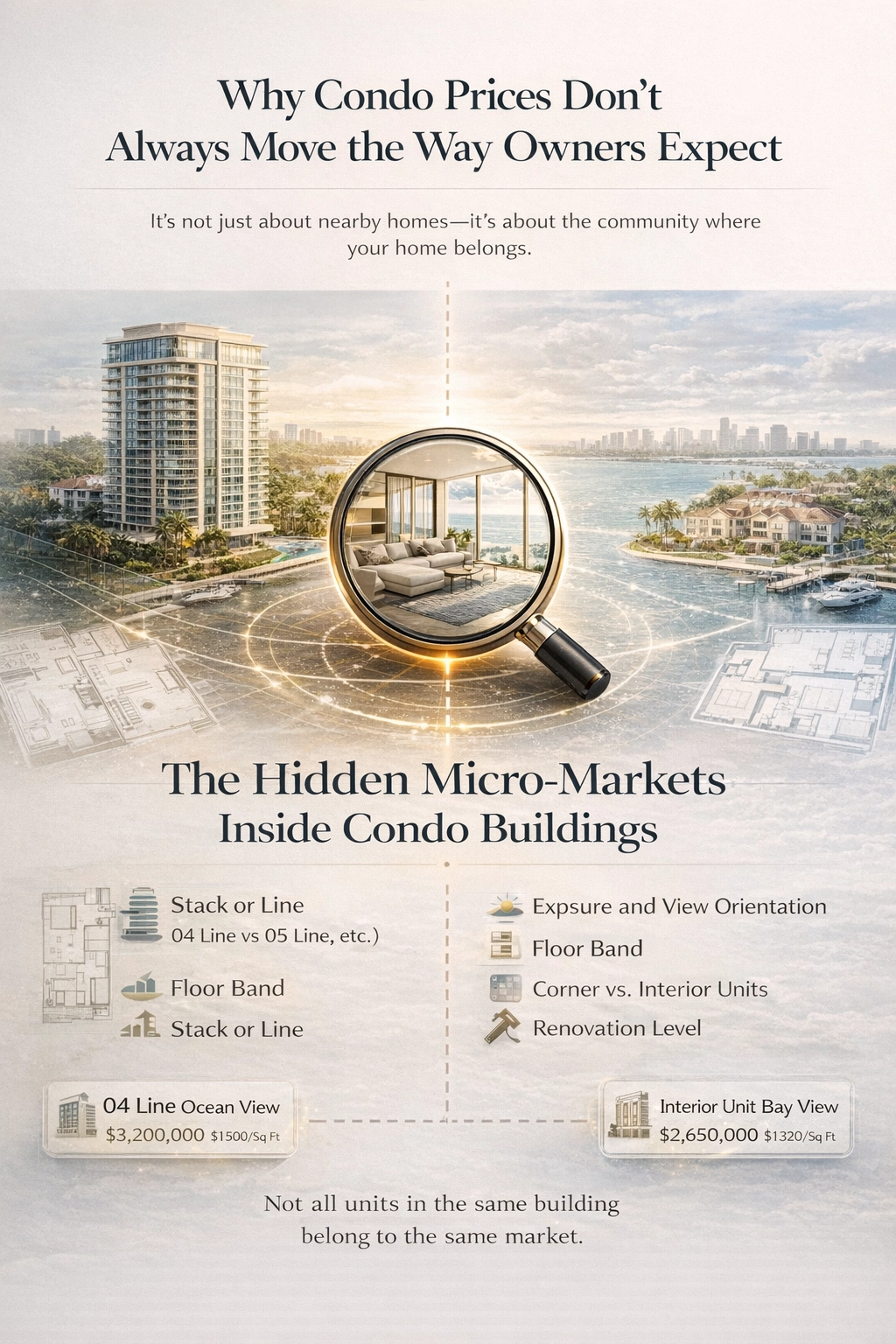
not all units in the same building belong to the same market.
The Hidden Micro-Markets Inside Condo Buildings
Most real estate platforms organize listings around simple attributes:
• address
• square footage
• price per square foot
• proximity.
But experienced agents know that pricing inside condo buildings is rarely that simple.
Buildings often contain multiple micro-markets defined by:
• stack or line (04 line vs 05 line, etc.)
• exposure and view orientation
• floor band
• corner vs interior units
• renovation level.
In some buildings, these differences can create 20–30% price variation between units that otherwise appear similar on paper.
From a data perspective, these are structural differences in the competitive set.
Buyers comparing units are often deciding between homes that share these characteristics — not simply any unit within the building.
Listings Don’t Show the Market Behind Them
Online listings tend to present properties as isolated listings rather than as part of a structured market.
This is why many condo owners rely on:
• their agent’s experience
• informal building knowledge
• recent sale discussions with neighbors.
Professionals mentally organize buildings into competitive sets.
For example:
A buyer interested in an 04 line high-floor ocean view unit will likely compare it against:
• other 04 line units
• similar exposure units in nearby buildings
• specific floors where view corridors matter.
The “market” is defined by these characteristics — not just by the building address.
Community Markets vs Listing Markets
This pattern extends beyond individual units.
Across South Florida, housing markets often operate around communities rather than broad geography.
In many cases, buyers compare homes within:
• the same condo building
• the same subdivision
• a cluster of similar waterfront developments.
These environments form the true competitive markets that influence pricing behavior.
Understanding that structure is often the difference between:
• interpreting a sale correctly
• or misreading what the market is signaling.
Structuring the Market Instead of Just Showing Listings
Most real estate platforms were built to display listings.
But listings are temporary events — not markets.
Understanding how property values behave requires structuring data around the environments where homes actually compete: communities, buildings, and the micro-markets within them.
Subdivisions.com was built with this principle in mind.
The platform organizes housing markets around subdivisions and condo buildings, structuring listings into the communities where buyers actually compare properties and where pricing signals form.
Over the past four years, Subdivisions.com has structured housing data across more than 20,000 residential communities spanning South Florida and the Gulf Coast, creating one of the most comprehensive community-level datasets in the region.
The goal isn’t simply to catalog neighborhoods.
It’s to provide market orientation — helping homeowners, sellers, and professionals see how properties compete within their real market environment.
Instead of asking:
“What listings are nearby?”
The more meaningful question becomes:
“Which homes are buyers actually comparing with mine?”
Because in real estate, that is where the market signal lives.
Why This Matters for Condo Owners
Experienced condo owners already understand that:
• not all units are equal
• views matter
• floor level matters
• building reputation matters.
But when markets shift — as they often do in South Florida — understanding the competitive structure behind those differences becomes increasingly important.
Because ultimately, the real estate market isn’t defined by listings.
It’s defined by the competitive environments where those listings meet buyers.
And in many cases, those environments exist inside the same building.

Comments