
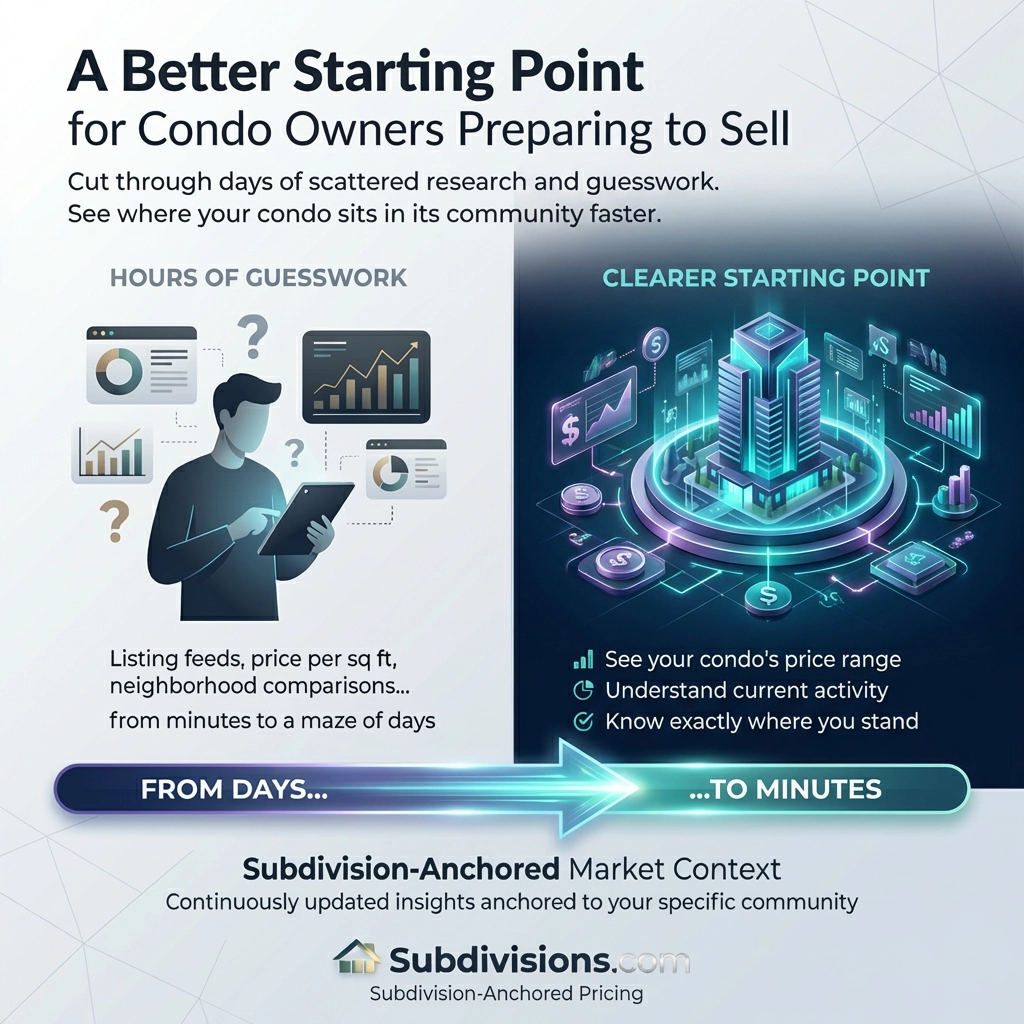

When condo owners begin thinking about selling, the first step is rarely a commitment. It’s research.
They open listing sites. They scan nearby sales. They compare price per square foot. They look at similar units in neighboring buildings and try to understand where their own condo might fit in the current market.
This process is familiar — and for informed owners, it’s intentional. The goal isn’t to land on a precise number. It’s to get oriented.
But in dense condo markets, that orientation can take longer than expected.
From Minutes to Hours — Then Days
What often starts as a quick check turns into hours of comparison. Listings that look similar on paper are priced very differently. Recent sales don’t always align with current asking prices. Some units sell quickly, others sit — without an obvious explanation.
Owners begin bookmarking listings, opening spreadsheets, and revisiting the same questions over multiple days:
Which of these sales actually applies to my condo?
Why does this unit trade differently from one that looks nearly identical?
Is the market signaling something I’m missing — or just changing?
This isn’t a lack of knowledge. It’s the friction of interpreting a market that has become increasingly granular and fragmented.
The Limits of Broad Estimates
Most online pricing tools start broadly — by zip code, radius, or citywide averages — before narrowing down. In high-density condo markets, that approach can introduce noise early in the process.
Two condos may share square footage, layout, finish quality, and building age, yet belong to different buyer pools and compete under different conditions. When that context is missing, owners can spend significant time trying to reconcile pricing signals that don’t quite line up.
The result is often uncertainty, not because owners are uninformed, but because the starting point lacks precision.
A Fair Exchange: Context for Time
Subdivisions.com was designed around a simple idea: provide meaningful market context earlier, so owners spend less time guessing.
Instead of starting with broad estimates or isolated comparable sales, owners can begin with subdivision-anchored market intelligence — a view of how similar condos within their actual community are trading right now. This approach reflects real buyer behavior and offers a clearer frame of reference before deeper analysis begins.
It’s not a final answer. It’s a more efficient first step.
By anchoring pricing insight to the subdivision level, Subdivisions.com helps owners move from scattered comparisons to a focused range — reducing the hours or days often spent trying to piece together fragmented information.
Why the Starting Point Matters
Preparing to sell a condo involves more than pricing. It involves timing, expectations, and confidence in the decisions that follow. When early research is grounded in clearer context, conversations with agents are more productive, questions are sharper, and decisions feel less reactive.
This is where the idea of a better default comes in.
Subdivisions.com doesn’t replace professional judgment or formal valuations. It refines the starting point — offering real-time, subdivision-based context that helps owners understand where their condo sits in today’s market before investing more time or resources.
In a market where information is abundant but interpretation takes effort, that exchange — clarity for time — can make a meaningful difference.

Comments