
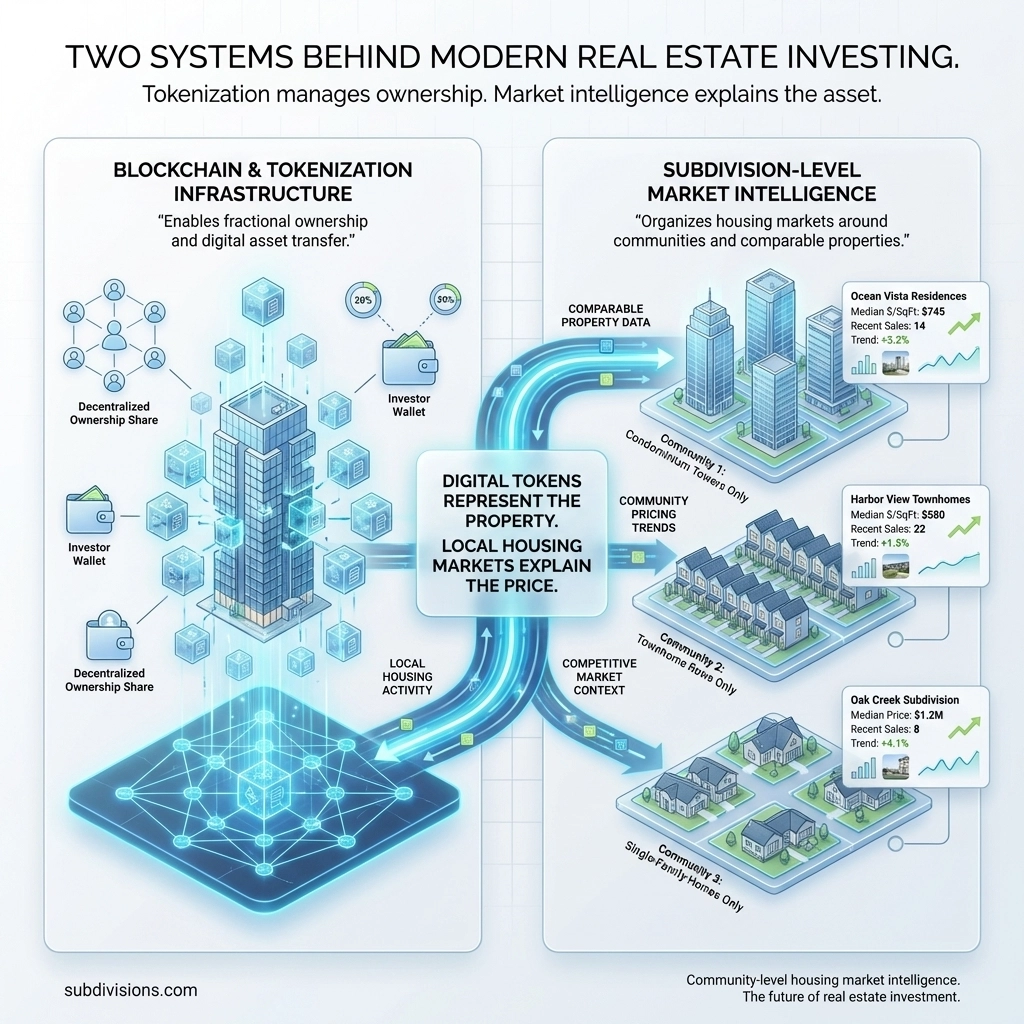

Real estate tokenization has become one of the most discussed ideas at the intersection of blockchain and property markets.
The concept is appealing: represent ownership of a property as digital tokens that can be transferred, fractionalized, or traded more easily than traditional real estate ownership structures. Proponents argue this could improve liquidity and broaden participation in an asset class that has historically been difficult to access or trade.
But behind the technological promise lies a practical question that every investor eventually confronts:
How do you determine whether the underlying property is fairly priced?
Tokenization can change how ownership is structured and transferred.
It does not change how real estate value is discovered.
Real Estate Value Is Still Determined Locally
Unlike many digital assets that trade on global exchanges, residential real estate markets are fundamentally local.
Property values are typically estimated by comparing a home with similar properties nearby—what real estate professionals call comparable sales, or “comps.” This approach has long been a standard practice used by appraisers, lenders, and investors to estimate property value.¹
In practice, those comparisons usually occur within very specific environments:
a condominium unit is compared with other units in the same building
a townhome is evaluated against similar homes in the same development
a single-family house is typically compared with homes in the same residential community
These comparable homes form what professionals call a competitive set.
Understanding that competitive set remains central to residential property valuation.
Housing Markets Are Structured Around Communities
Although online real estate searches often organize listings by city or ZIP code, residential housing markets typically function at a much smaller scale.
Within cities and neighborhoods exist residential communities—commonly referred to in real estate as subdivisions—that group homes with similar characteristics.
These communities may include:
condominium buildings
townhome developments
planned single-family home neighborhoods
sections of larger master-planned communities
Homes within the same community often share key attributes:
similar architectural design
comparable layouts and square footage
shared amenities such as pools, gyms, or security
common homeowners association structures
similar construction periods
Because of these similarities, homes within the same community frequently compete with one another in the market.
For this reason, pricing comparisons are typically most meaningful within the same residential community.²
The Data Challenge for Tokenized Real Estate
Tokenization platforms may allow investors to participate in real estate markets across cities, states, or even countries.
However, this accessibility creates a new challenge: many investors evaluating tokenized real estate assets may have limited familiarity with the local housing markets where those assets exist.
Without local context, it becomes difficult to answer important questions such as:
How do comparable homes in the same community compare in price?
What recent transactions have occurred within the development?
How does supply and demand behave within that specific residential area?
These factors can significantly influence the performance and risk profile of residential real estate investments.
For tokenized property markets to operate effectively, investors still need reliable insight into the local competitive environment surrounding the asset.
Why Community-Level Data Matters
Much of the public real estate data available online is organized around individual listings or large geographic areas such as cities and ZIP codes.
While this structure can help users discover available properties, it may not always reveal how a particular residential community is performing as a market.
Organizing housing activity around subdivisions and residential communities provides a more structured way to understand local housing dynamics.
Instead of viewing properties as isolated listings scattered across a city, analysts can examine how homes behave within the communities where comparable properties actually compete.
Platforms such as Subdivisions.com focus on structuring housing data around this community layer of the market—organizing listings, comparable sales, and housing activity within residential subdivisions rather than treating properties as isolated assets across a broader geography.
For investors analyzing residential real estate—including those exploring tokenized property opportunities—this type of structured local context can provide additional perspective when evaluating assets.
Technology Evolves. Markets Still Need Context.
Blockchain technology may introduce new ways to structure ownership, automate transactions, and distribute investment opportunities in real estate.
But the underlying asset remains a physical property located within a local housing ecosystem shaped by comparable homes, community characteristics, and neighborhood dynamics.
Tokenization may change how real estate ownership is packaged and transferred.
Understanding its value, however, still depends on something far more traditional:
local market intelligence.
Because whether a property is owned directly, through a fund, or through digital tokens, it still exists within a community where homes compete and prices are ultimately discovered.
The Market Behind the Asset
Every real estate asset—tokenized or not—exists within a broader housing market.
Listings represent individual properties.
Tokens may represent fractional ownership.
But understanding the value of the underlying asset still requires examining the market around it.
And in residential real estate, that market is often defined by the community where comparable homes exist.
References
The Appraisal Foundation – Uniform Standards of Professional Appraisal Practice (USPAP) and comparable sales methodology.
Federal Housing Finance Agency (FHFA) – House Price Index methodology and appraisal practices rely heavily on comparable property analysis within local markets.
Comments