
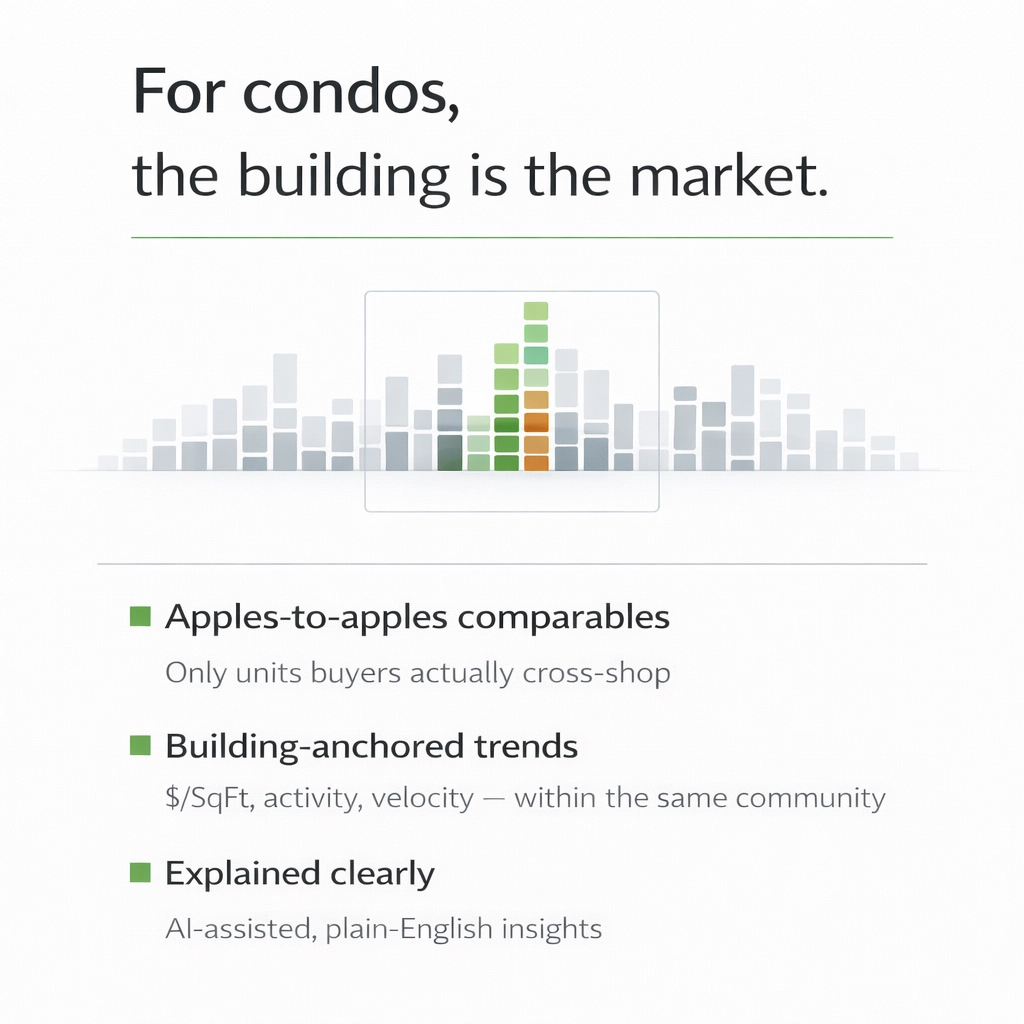

Why Subdivisions.com built “Subdivision Home Value” around apples-to-apples comparables—not generic proximity
If you’ve ever asked “What’s my condo worth?”, you’ve probably noticed something frustrating: the answers often feel vague.
That’s not because condos are impossible to price. It’s because condos don’t behave like single-family homes.
In many markets—especially high-rise and mid-rise “vertical living”—a condo’s value is defined by the building (and the community) first. Not the neighborhood. Not a radius. Not a generic map pin.
That’s the simple idea behind Subdivision Home Value on Subdivisions.com:
When a building defines how buyers compare units, we treat that building as the micro-market.
Why condo pricing is different
Condo buyers don’t shop “nearby.” They shop substitutes.
If a buyer likes your building, they typically compare your unit against:
other units in the same building
units with a similar stack/line
similar view/exposure
similar layout and size
recent sales with similar condition/finish level (when verifiable)
That’s apples-to-apples.
And when condo owners are trying to understand pricing, they usually want the same thing:
“Show me what units like mine are actually trading for—here.”
The problem with generic “home value” tools (for condos)
Most consumer tools are built to work everywhere, which means they often have to generalize. For condos, that can lead to comparisons that feel “off,” because they may include properties that don’t truly compete with yours.
In vertical markets, small differences can have a big impact:
a different line can mean a different view
a different exposure can change natural light and heat
a higher floor can change price-per-square-foot
building amenities and reputation can shift buyer demand
A condo owner doesn’t need more noise. They need context.
What Subdivisions.com does differently: “building-anchored” context
Subdivision Home Value is designed as a homeowner-first pre-CMA experience.
It helps you answer:
What’s the value range implied by recent sales in my building/community?
Which sold units are most comparable to mine (apples-to-apples)?
What’s the building doing overall in $/SqFt and activity?
What changed recently that might affect my unit?
Instead of starting broad and narrowing down, we start where condo value is usually most defined:
your building or community.
Apples-to-apples comparables (what that actually means)
Not all “comps” are equal.
Subdivisions.com prioritizes comparables that are meaningful alternatives to your unit, such as:
stack/line (especially important in towers)
view and exposure
floor plan and size
recent sales activity (with the time window expanded only when necessary)
We also show additional building activity as market context, so you can see the broader pricing picture without mixing in less comparable units as direct comps.
Why we pair visuals with an AI assistant
Most homeowners don’t want a wall of numbers. They want to understand what the market is doing—quickly.
That’s why the experience includes:
clear data visualizations (pricing trends, activity, $/SqFt context)
an AI assistant that explains what you’re seeing in plain English
next-step options when you need a licensed pro
It’s not meant to replace professional judgment. It’s meant to make the market easier to understand before you make decisions.
Who this is built for (in real life)
Primary users
Condo owners planning to sell, refinance, or simply understand their building’s market reality
Condo buyers who want stronger negotiation context and better comparisons
Also useful
Agents who need clean building-level context to educate clients quickly
Appraisers and lending professionals who benefit from additional building activity context for research support
Not an appraisal—and not trying to be
Subdivision Home Value is provided for informational and educational purposes only. Some decisions—especially lending and legal uses—require a licensed appraisal.
Our goal is different:
give condo owners and buyers a credible, building-anchored starting point they can use from home.
Where we’re going next
We’re starting with condos because vertical living is where community boundaries and comparable logic are often the clearest.
Over time, we plan to expand into additional property types (like low-rise communities, townhomes, and single-family homes) with property-type-specific methodologies—because each behaves differently and deserves its own comparable logic.
Try it: a faster way to understand your building’s market
If you own (or are buying) a condo, Subdivision Home Value is designed to help you see your building’s pricing pattern and true comparables—without jargon.
Start with your building/community and unit number, and view your building-anchored home value range.

Comments