
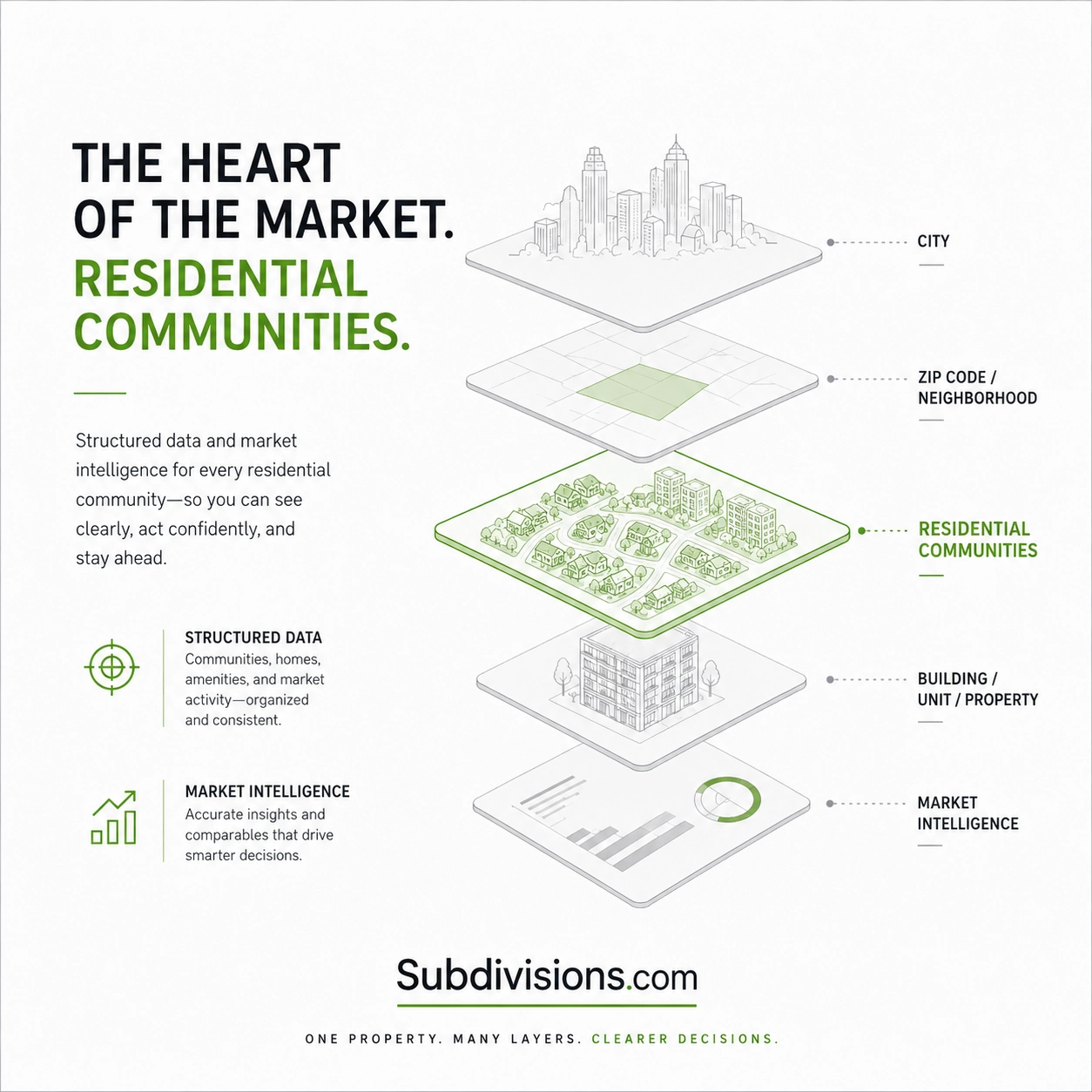

Between broad geography and the individual property sits a residential community layer—subdivisions, condo towers, townhome developments and residential complexes. Real estate professionals work in this layer every day. Technology has not consistently structured it.
By Jake Miakota
Real estate technology has become remarkably good at organizing geography.
We can identify a property by address, locate it within a city and ZIP code, place it inside a neighborhood and display everything around it on a map.
That structure works extremely well for discovery.
But as soon as the question changes from “Where is this property?” to “What does this property actually compete with?”, the data problem changes too.
Between broad geography and the individual home sits another layer of residential real estate: subdivisions, HOA communities, gated developments, townhome communities, condominium complexes, individual towers and, in dense markets, even different property segments within the same building.
I think of this as the residential community layer.
It is not new. Appraisers and real estate professionals have been working in it for decades.
What is still developing is the infrastructure to represent that layer consistently as data.
Geography provides orientation. Communities provide context.
A ZIP code is useful, but a ZIP code can contain very different housing markets.
A neighborhood is more specific, but a neighborhood can contain single-family subdivisions, waterfront communities, townhome developments and condominium towers occupying very different price positions.
Even a single condo tower can contain meaningful internal differences based on unit type, floor, line, layout, exposure, view, amenities and ownership costs.
The deeper the analysis goes, the less useful it becomes to think only in terms of progressively smaller geographic circles.
What begins to matter are relationships.
What community is the property part of?
What kind of housing exists within that community?
Which properties are reasonable comparisons?
What is competing for similar demand today?
Which other communities represent realistic alternatives?
Where does the property appear to sit within that competitive environment?
That is a different information problem from locating a pin on a map.
Professionals already assemble this layer manually
This is where the distinction becomes important.
A knowledgeable real estate agent preparing for a listing appointment rarely stops at a city or ZIP-code statistic. The professional looks at the subdivision or building, recent relevant sales, active competition, differences between properties and sometimes competing communities a buyer might consider instead.
Appraisers perform a more formal version of market analysis.
Fannie Mae and Freddie Mac now distinguish a property's market area from its neighborhood. Fannie Mae defines the market area around the geographic region from which demand for the subject comes and where its competition is located. It specifically notes that two side-by-side properties can have different market areas when their characteristics appeal to different market segments.
Freddie Mac similarly says fixed-distance rules such as a one-mile radius are not good proxies for neighborhood boundaries and describes market areas in terms of similar demand and competition.
The industry therefore already recognizes the underlying principle:
proximity and market relevance are not the same thing.
But much of the work required to determine relevance is still performed assignment by assignment.
A professional searches.
Filters.
Reviews.
Rejects weak comparisons.
Adds local context.
Checks current competition.
Reconciles differences.
Then interprets what the evidence means.
The knowledge exists. What is often missing is a persistent structure that allows those relationships to be reused instead of rediscovered.
A subdivision name is a field. A residential community is an entity.
Real estate data standards have made major progress.
RESO's Data Dictionary provides standardized names, definitions and data types so different real estate systems can exchange information more consistently.
It even includes a SubdivisionName field, defined broadly as a neighborhood, community, complex or builder tract.
But this illustrates the next challenge.
A standardized field tells software where to put the name.
It does not necessarily establish everything behind the name.
Are two spelling variations the same community?
Does a condominium complex contain three separate towers?
Is the tower itself the relevant market, or does the competitive set extend into peer buildings?
Does one subdivision contain materially different property products?
Which nearby communities occupy the same price segment?
Those are entity and relationship questions.
They require identity resolution, normalization, classification and ongoing curation.
RESO itself continues working on geography and interoperability issues, including a Schools & Geographies subgroup focused on standardizing cities, subdivisions, schools, counties and postal-code requirements.
The direction is clear: standardizing individual fields is essential, but higher-order market intelligence requires understanding how the entities represented by those fields relate.
This layer goes deeper—and then wider
There is a temptation to describe hyperlocal intelligence as simply “zooming in.”
That is only half the story.
Residential market analysis often moves deeper first:
City
→ ZIP code
→ Neighborhood
→ Residential community
→ Building
→ Unit or property type
Then it may need to move outward again:
Property
→ relevant sales
→ active competition
→ peer properties
→ comparable communities
→ broader market alternatives
That matters because the best comparison may not always be the geographically closest property.
A condo owner may have excellent evidence inside the same tower but also compete against similar units in several neighboring buildings.
A single-family homeowner may live in one subdivision while buyers routinely compare it with two or three nearby communities in the same general price and housing segment.
The community provides the starting context.
The competitive relationships define the market around it.
AI makes this structure more important
This is where the AI conversation becomes particularly interesting.
AI can dramatically reduce the cost of processing records.
Give a model thousands of listings, sales, public records and property descriptions and it can extract, summarize and classify information at a speed that was impractical only a few years ago.
But processing more records does not automatically produce better market intelligence.
The system still has to understand what belongs together.
A model needs to distinguish an address from a building, a building from a larger residential complex, a nearby sale from a relevant comparable and a neighboring community from a genuine market alternative.
Otherwise, faster processing can simply produce faster noise.
AI can process the records. Someone still has to define the relationships.
That may be one of the more important data-infrastructure challenges facing residential real estate.
From professional workflow to market infrastructure
The opportunity is not to replace the work of real estate professionals or appraisers.
It is to structure more of the environment in which that work already occurs.
Think of the progression this way:
Geography provides orientation.
Residential communities provide context.
Property relationships establish relevance.
Market intelligence extracts meaning.
Decision support makes the information useful.
The industry already has enormous amounts of property data.
What it does not yet have everywhere is the same level of structure around the residential markets those properties participate in.
That is why I believe an important next step in real estate technology will happen between the broad geographic layers we already understand and the individual property record.
Not because the residential community layer is new.
Because we are finally reaching the point where something professionals have reconstructed manually for decades can begin to become persistent market infrastructure.

Comments