
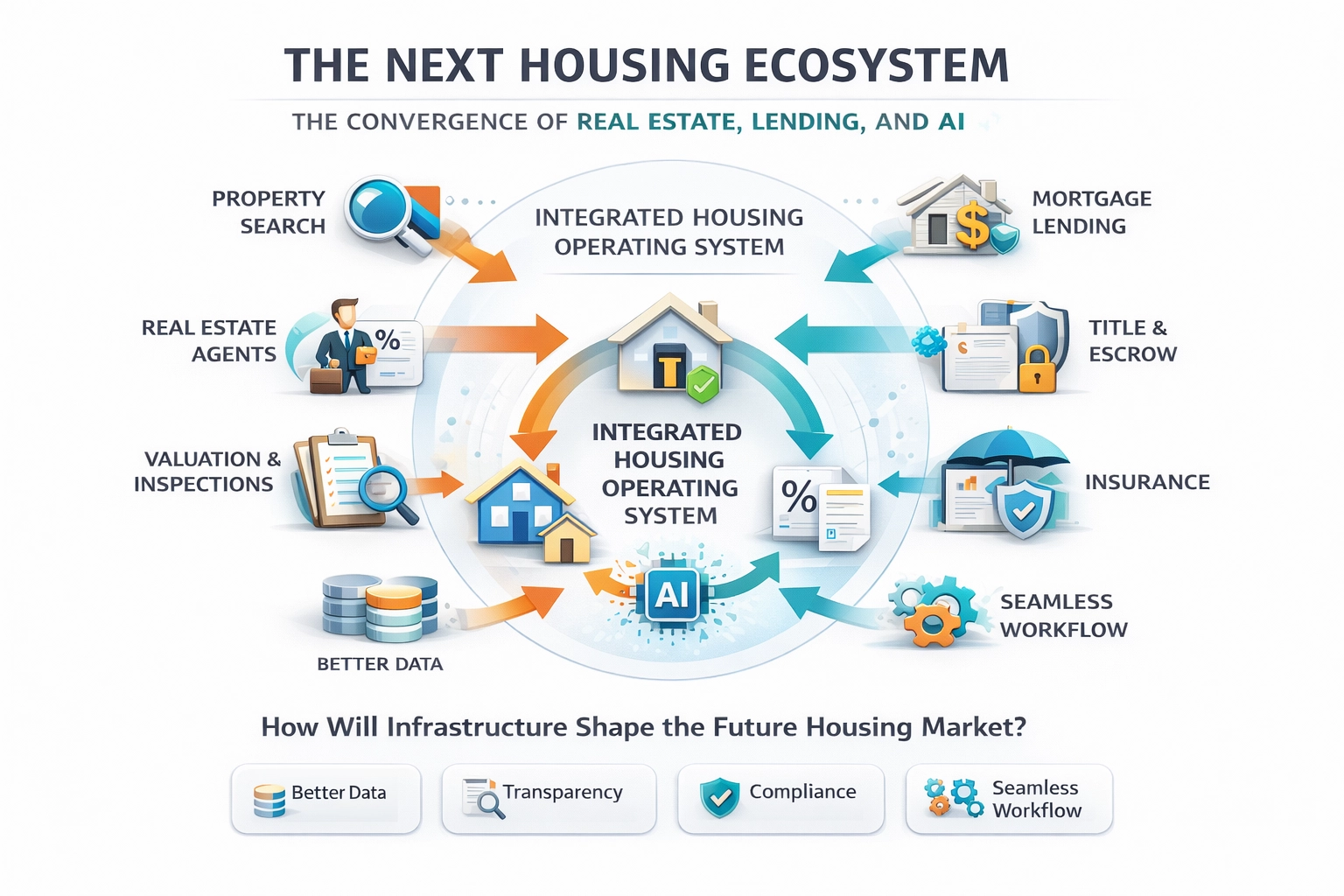

For decades, the housing industry operated through a fragmented model.
Consumers searched for homes on one platform, worked with a real estate agent through a brokerage, and secured financing through a completely separate lender. Title services, insurance providers, inspectors, and closing agents all operated in parallel but largely disconnected systems.
The process worked — but it was inefficient.
Now the structure of the housing industry is beginning to change.
The shift is not just technological.
It is structural.
And artificial intelligence is accelerating it.
The convergence already underway
Recent moves by major industry players show how quickly the boundaries between sectors are disappearing.
Zillow entered the mortgage industry after acquiring Mortgage Lenders of America in 2018 and now operates Zillow Home Loans. Rocket Companies, historically a mortgage platform, has been expanding into real estate through initiatives including its planned acquisition of Redfin.
The logic behind these moves is straightforward: whoever controls the starting point of the homeownership journey gains strategic influence over everything that follows.
Search leads to agents.
Agents lead to financing.
Financing connects to title, insurance, and closing services.
This is why the competition is no longer about listings or loan rates alone.
It is about control of the housing transaction pipeline.
The broader housing services economy
Real estate search and mortgage lending represent only two components of the housing transaction.
The full ecosystem also includes:
Title insurance and escrow services
Property and hazard insurance
Appraisal and valuation services
Inspection and due diligence providers
Settlement and closing coordination
Compliance and document management
Each of these industries generates billions of dollars annually and plays a critical role in completing a home transaction.
But today, these services remain fragmented.
From a consumer’s perspective, the homeownership journey still requires navigating multiple companies, platforms, and professionals — often with little coordination between them.
This fragmentation creates both friction and opportunity.
Regulation shapes how integration can occur
Unlike many technology sectors, the housing industry operates within a heavily regulated environment.
The Real Estate Settlement Procedures Act (RESPA) governs how settlement service providers interact. Under Regulation X, companies are prohibited from offering kickbacks or referral fees in exchange for directing consumers to specific service providers.
RESPA also requires clear disclosure of settlement costs through standardized forms such as the Loan Estimate and Closing Disclosure, overseen by the Consumer Financial Protection Bureau (CFPB).
Additional regulations include:
State licensing requirements for title agents and settlement providers
Appraisal independence rules for mortgage underwriting
FinCEN reporting requirements for certain real estate transactions involving legal entities or non-financed purchases
These frameworks exist to protect consumers and prevent conflicts of interest.
They also shape how integrated housing platforms must operate.
Future housing ecosystems cannot simply bundle services together.
They must do so transparently, compliantly, and without bias.
The real challenge: building a housing operating system
Many companies now envision a seamless consumer experience where a buyer can:
Search for a property
Connect with an agent
Secure financing
Obtain insurance
Coordinate inspections and due diligence
Complete settlement and closing
All within a single digital workflow.
This idea is often described as the “end-to-end homeownership platform.”
But achieving it requires more than connecting services.
It requires a shared infrastructure layer capable of organizing housing data, coordinating service providers, and guiding consumers through the transaction process.
In other words, it requires something closer to an operating system for housing.
Why AI will accelerate this shift
Artificial intelligence is beginning to transform how housing data is interpreted and used.
AI systems can summarize listings, analyze market trends, assist buyers with search, and help lenders evaluate risk. These capabilities are already appearing across real estate platforms and fintech tools.
But AI has a fundamental limitation.
It can only reason effectively when the underlying data is structured correctly.
Residential real estate markets are notoriously complex. Most platforms still organize housing data around broad geographic categories such as cities, ZIP codes, or neighborhoods.
Yet pricing dynamics rarely behave at those levels.
In practice, competitive pricing often forms within far more granular environments:
subdivisions in single-family housing
individual condominium buildings
specific housing communities
stack, tier, and exposure differences within high-rise developments
Without this level of structure, AI models struggle to interpret housing markets accurately.
This is why the future housing ecosystem will depend not only on integration, but on better market intelligence infrastructure.
The risk of ignoring structural change
For companies operating under traditional housing models, the risk is not simply technological disruption.
It is strategic displacement.
As large platforms consolidate search, financing, and transaction services, smaller or disconnected providers may find themselves increasingly dependent on ecosystems they do not control.
Visibility, customer access, and pricing power may shift toward platforms that own the consumer entry point.
This dynamic has already played out in industries such as travel, advertising, and retail.
Housing may be following the same trajectory.
The companies that adapt early will help shape the new ecosystem.
Those that ignore these changes may eventually operate within it on someone else’s terms.
The next phase of the housing industry
The convergence of real estate platforms, fintech companies, and AI-driven tools suggests that the housing industry is entering a new phase.
Future housing systems will likely integrate:
property search
market intelligence
real estate professionals
financing platforms
insurance providers
title and settlement services
within coordinated digital workflows.
But integration alone will not determine success.
The platforms that succeed will be those that understand how housing markets actually function — and build infrastructure around that reality.
Because at the center of every housing transaction is a deceptively simple question:
What is this property truly competing with in the market?
In the emerging housing ecosystem, the ability to answer that question with clarity may become one of the most valuable capabilities of all.

Comments