
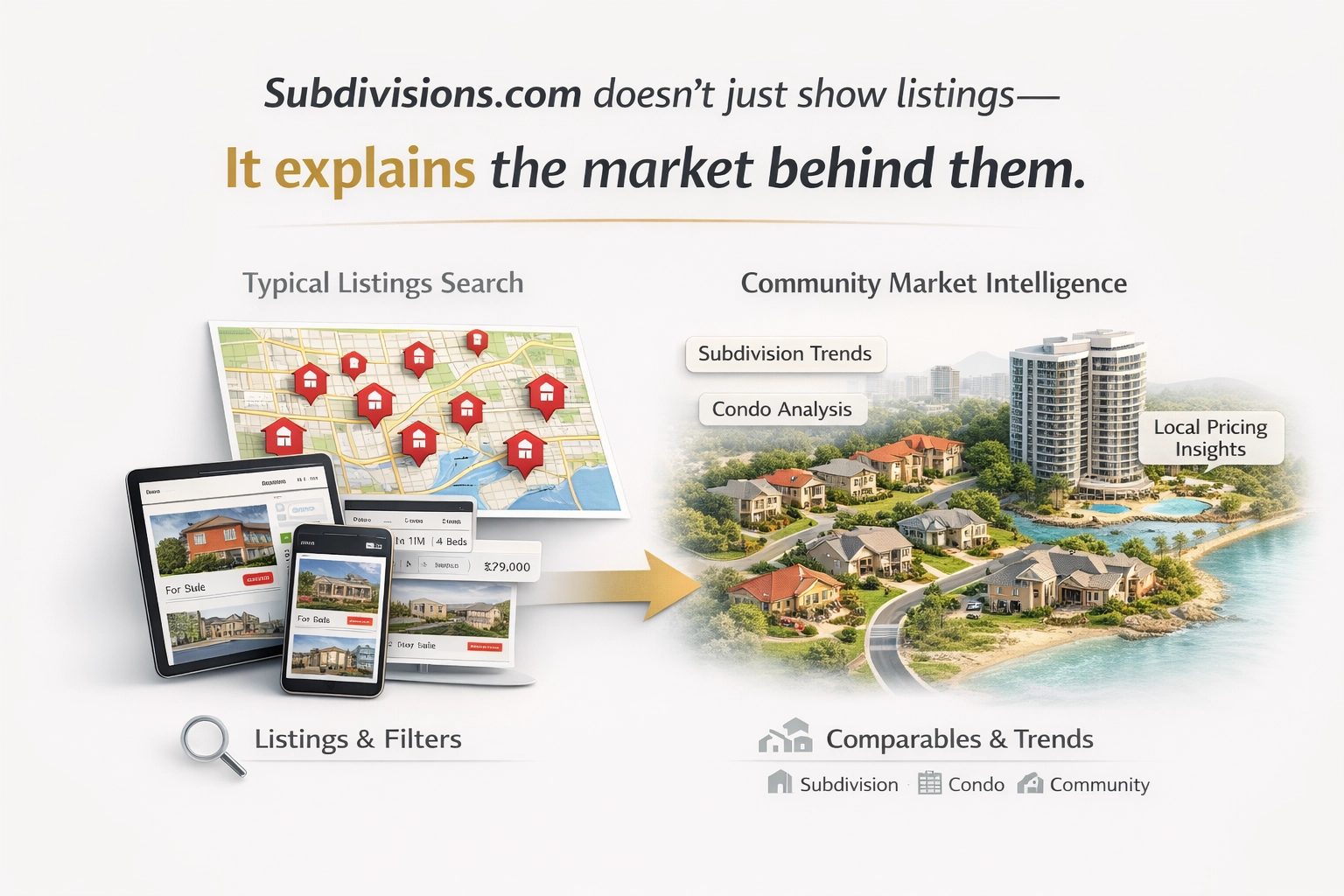

For more than two decades, real estate technology has focused on one central idea: listings.
Open any major real estate platform and the experience looks familiar. Homes are displayed on maps, filtered by price ranges, bedrooms, or ZIP codes, and sorted into lists of properties currently for sale.
Listings are important. They represent the moment a property enters the market.
But listings alone do not explain how the housing market actually works.
Behind every listing is a competitive environment — a market where buyers compare properties and decide what they are willing to pay. Understanding that environment is often the difference between simply browsing homes and making a confident real estate decision.
Listings Are Events. Markets Are Structures.
A listing represents a single event: a home offered for sale at a particular moment in time.
But the housing market is not a collection of isolated events. It is a network of communities where properties compete for buyers.
These communities may be:
subdivisions
condominium buildings
planned developments
residential clusters with shared characteristics.
Within these environments, homes tend to compete directly with each other. Buyers comparing properties are usually evaluating homes within the same subdivision or building rather than across an entire city or ZIP code.
Yet most real estate platforms still organize data primarily around:
listings
geographic proximity
ZIP codes
price averages.
This structure can obscure the signals that actually shape housing markets.
Why Community-Level Markets Matter
Housing markets often behave very differently at the community level.
Two homes located only a few streets apart may belong to entirely different subdivisions, attracting different buyers and commanding different price ranges.
In condominium markets, the dynamics can be even more nuanced. Within the same building, factors such as floor level, view orientation, or stack position can influence pricing patterns.
Experienced real estate professionals recognize these distinctions instinctively. They know that the most relevant comparisons are not always the nearest properties on a map, but the homes that buyers actually evaluate side by side.
Those homes form the true competitive market.
Understanding that market structure is essential for interpreting price signals accurately.
The Importance of Apples-to-Apples Comparables
Real estate decisions often rely on comparable sales.
But the reliability of those comparisons depends on identifying the correct competitive environment.
A home evaluated against the wrong set of comparables can appear:
overpriced
underpriced
or inconsistent with market trends.
The key question is not simply:
“What homes are nearby?”
The more meaningful question is:
“Which homes are buyers actually comparing this property against?”
Answering that question requires organizing property data around the communities where competition occurs.
Structuring the Market Instead of Just Showing Listings
Subdivisions.com was built around this principle.
Rather than focusing only on listings, the platform structures residential housing data around subdivisions, condo buildings, and communities — the environments where homes actually compete.
Over the past four years, Subdivisions.com has mapped and organized data across more than 20,000 residential communities throughout South Florida and the Gulf Coast, creating one of the most comprehensive community-level datasets in the region.
This approach allows the platform to provide insights that go beyond traditional listing searches, including:
apples-to-apples comparable analysis
community-level pricing trends
subdivision-based market positioning
location intelligence that reflects how buyers evaluate properties.
By structuring housing markets around communities, listings become part of a defined competitive context, rather than isolated data points.
From Listings to Market Intelligence
Residential real estate represents more than $45 trillion in household assets in the United States, according to the Federal Reserve.
In a market of that scale, understanding how housing markets function is critical for homeowners, buyers, lenders, and investors.
Listings will always remain an essential part of the real estate process.
But listings alone do not explain the market behind them.
By organizing housing data around the communities where properties actually compete, platforms like Subdivisions.com are helping transform fragmented property information into clearer market intelligence.
Because ultimately, the most important insight in real estate isn’t simply which homes are for sale.
It’s understanding the market those homes belong to.

Comments