

When people talk about where they live, they usually mention a neighborhood.
Someone might say they live in Brickell, Coral Gables, Boca Raton, or Weston. Neighborhood names help people describe general areas of a city and give others a quick sense of location.
But when it comes to how real estate markets actually work, there is another layer that matters even more.
Inside every neighborhood are residential communities where homes truly compete with one another. In real estate, these communities are called subdivisions.
And while the word may sound technical, the concept is very simple.
A subdivision is simply a residential community.
It might be:
a condominium tower
a group of condo towers
a single-family home community
a townhome development
or a section within a larger master-planned community
In other words, the places people often refer to as “the community” or “the building” are what real estate professionals call subdivisions.
The Hidden Structure of Housing Markets
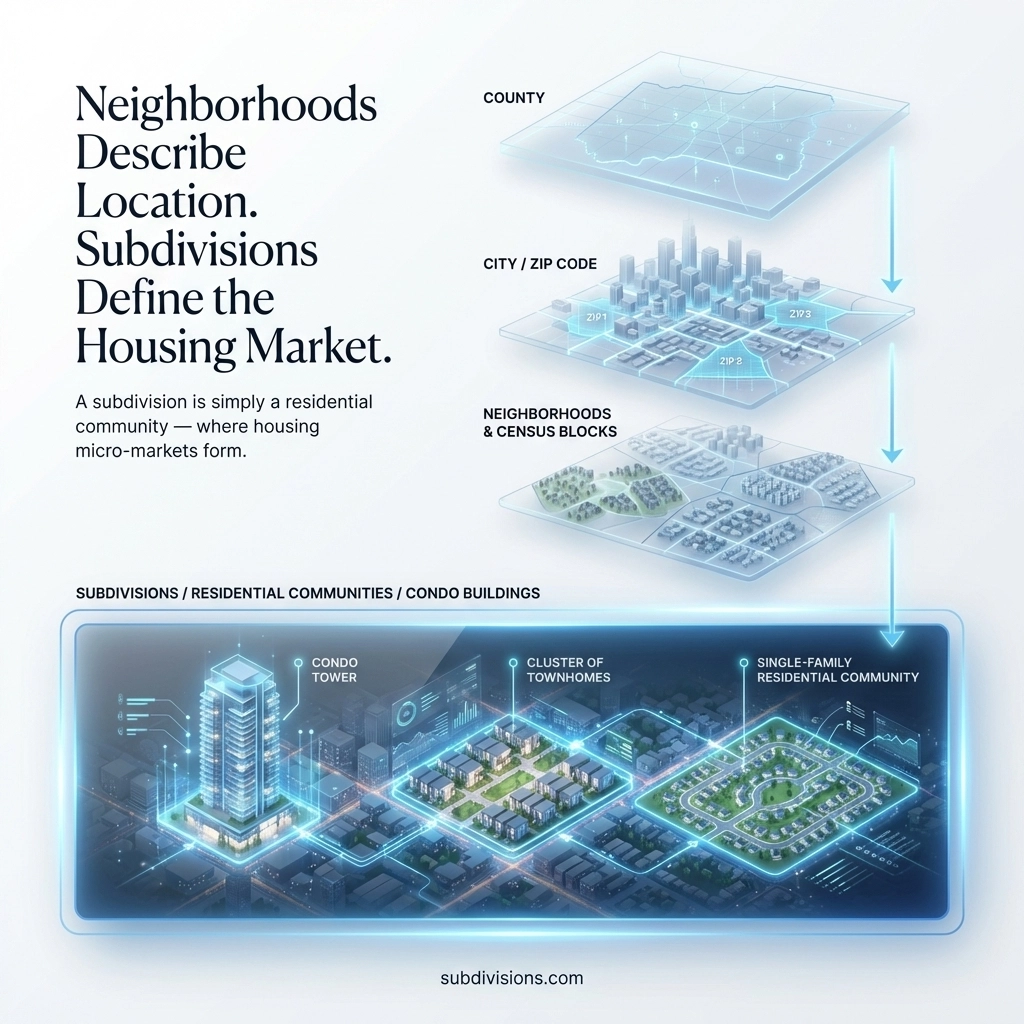
Real estate markets are organized in layers.
Most people think about location using neighborhoods, but housing markets operate at a more detailed level.
A simplified structure looks like this:
County
↓
City or ZIP Code
↓
Neighborhoods and Census Blocks
↓
Subdivisions (Residential Communities or Condo Buildings)
Neighborhoods describe where homes are located geographically.
But subdivisions define where homes actually compete in the housing market.
A single neighborhood can contain many different subdivisions, each with its own pricing patterns, housing styles, and buyer demand.
These smaller markets are often referred to as housing micro-markets.
Why Subdivisions Form Housing Micro-Markets
Homes located within the same residential community tend to share many characteristics that influence how buyers compare properties.
For example, homes in the same subdivision often share:
similar construction periods
comparable home sizes and layouts
the same architectural style
common amenities such as pools or clubhouses
the same homeowners association
a similar lifestyle profile that attracts similar buyers
Because of these shared characteristics, buyers typically compare homes within the same residential community when deciding what a property is worth.
This is why real estate professionals — including agents and appraisers — rely heavily on comparable sales within the same subdivision or building when evaluating value.
In practical terms, the subdivision becomes the competitive arena of the housing market.
Example: Condo Buildings as Subdivisions
In dense urban areas, a single condominium building often functions as its own subdivision.
Take the Brickell district of Miami, which contains dozens of residential towers.
A buyer may begin searching within the Brickell neighborhood, but once they focus on a specific building — such as Icon Brickell — the real comparison begins.
Units inside that building are typically compared with other units in the same building, where the floor plans, amenities, and construction quality are similar.
Even though nearby towers share the same neighborhood, they may have different pricing trends and buyer demand.
Each building therefore functions as its own housing micro-market.
Example: Subdivisions in Suburban Cities
The same principle applies to suburban housing markets.
A city like Weston, Florida contains many residential communities.
A buyer considering homes in the Savanna community will usually compare those homes against other properties within Savanna rather than every home across Weston.
Over time, each residential community develops its own market behavior based on:
housing inventory
amenities and lifestyle features
home design and architecture
buyer demand
These communities become distinct housing micro-markets within the larger city.
Why Individual Listings Don't Tell the Full Story
Most online home searches revolve around individual listings.
While listings are essential for discovering available homes, a single listing represents only one moment in the market — one property at a specific time.
Without understanding the residential community surrounding that listing, it can be difficult to interpret what the price actually means.
A single listing cannot easily reveal:
pricing trends within the community
how homes nearby are performing
how price per square foot compares within the subdivision
whether the community is gaining or losing demand
To understand those patterns, properties must be analyzed within the subdivision or residential community they belong to.
Why the Subdivision Data Layer Matters
When housing data is organized around subdivisions, something powerful happens.
Individual listings begin to form structured housing markets.
At the subdivision level, it becomes possible to analyze:
median price per square foot
historical pricing trends
comparable sales patterns
supply and demand dynamics
how one community compares with nearby residential communities
These insights are difficult to generate when looking only at scattered listings across an entire city or neighborhood.
The subdivision layer connects individual properties into meaningful market intelligence.
A Clearer Way to Understand the Housing Market
Neighborhood names will always remain a helpful way to describe general areas of a city.
But inside those neighborhoods exist multiple residential communities — subdivisions, condo buildings, and planned developments — each forming its own housing micro-market.
Understanding those communities provides a much clearer picture of how homes compete, how prices evolve, and how real estate markets truly function.
Sometimes the most important housing insights are not found at the neighborhood level, but within the subdivisions and residential communities where the market actually takes shape.

Comments