

Most online real estate searches begin the same way.
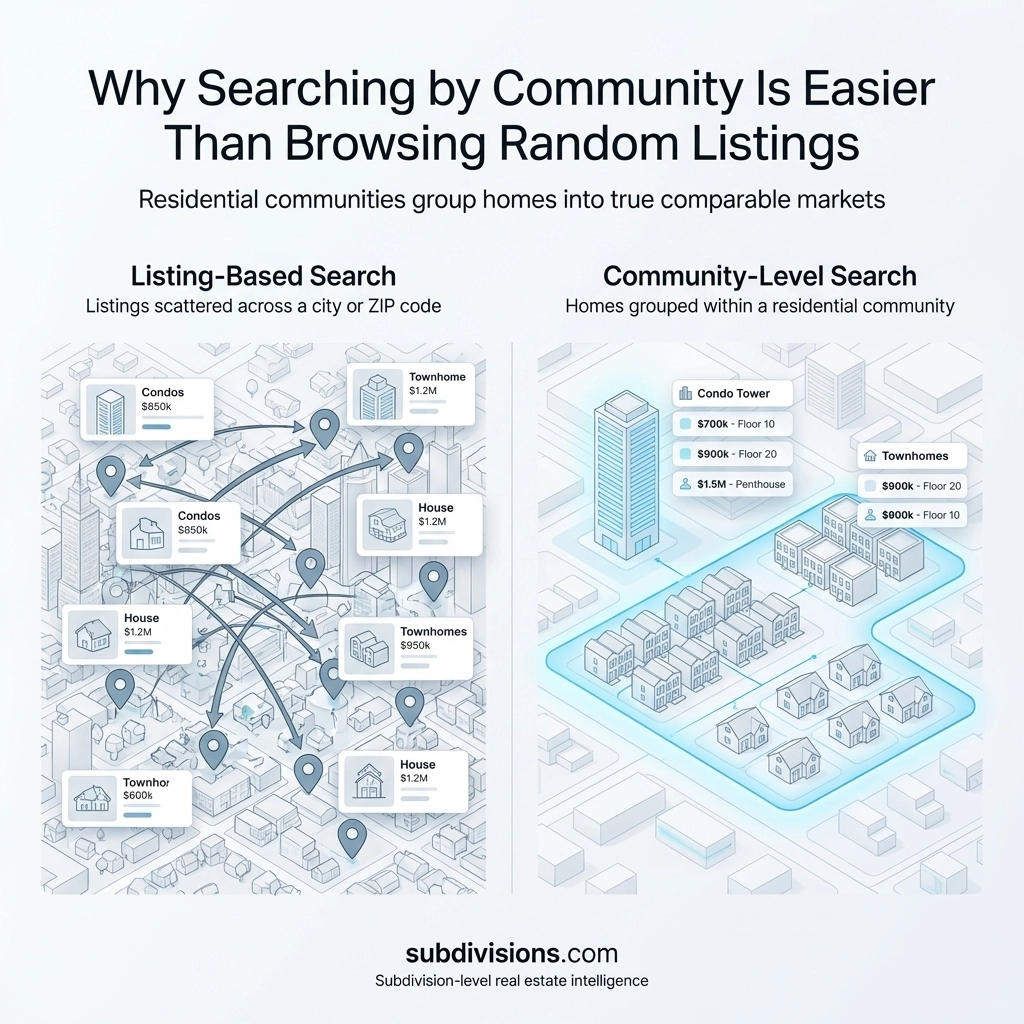
A person enters a city or ZIP code into a national real estate portal and is presented with a stream of property listings spread across the area. Homes from multiple neighborhoods and residential communities appear side by side, often mixed together in a single feed.
While this approach helps people discover available properties, it can make it difficult to understand how homes actually compare within the same community.
And for many local residents, that comparison is exactly what they want to see.
The Problem With Listing-Centric Search
Most national real estate platforms are designed around individual listings.
When someone searches within a city or ZIP code, results often include homes from many different residential communities. A condominium unit in one building may appear next to a property in a completely different development across town.
These listings may technically be within the same city or neighborhood, but they often belong to very different housing markets.
As a result, it can be surprisingly time-consuming for homeowners or buyers to locate and compare properties within the same residential community.
For example, a homeowner who wants to understand what is happening in their own building or community development may have to scroll through many listings from surrounding areas before finding the homes that are truly comparable.
Why Communities Matter in Real Estate
In real estate, homes are usually compared within what professionals call a competitive set.
A competitive set includes homes that share similar characteristics, such as:
similar architecture
comparable home sizes and layouts
the same homeowners association
shared amenities like pools or clubhouses
similar construction periods
These comparable homes are most often located within the same residential community.
In real estate terminology, these communities are known as subdivisions.
A subdivision might be a condominium building, a townhome development, or a single-family home community. Within these communities, homes tend to share similar characteristics and compete directly with one another.
Because of this, subdivisions often function as housing micro-markets.
Why Many Buyers Start With a Community
For many local residents, the search for a home begins with a community they already recognize.
They may know the community because:
they live nearby
friends or family members live there
they pass the development during their commute
they are familiar with the architecture or amenities
Someone might say:
“I like those condos by the marina.”
“My friend lives in Savanna.”
“That community near the park is nice.”
In these situations, the focus is not on browsing random listings across a city. The focus is on understanding what is happening inside that particular community.
From Scattered Listings to Community-Level Insight
Searching by subdivision or residential community organizes homes into a clearer structure.
Instead of looking at properties scattered across a city, homes can be grouped within the community where they actually compete.
This makes it easier to see:
what homes are currently available in that community
recent sales and comparable properties
how prices compare within the same development
how the local housing market is evolving
In other words, the housing market becomes easier to understand when homes are viewed within the residential communities they belong to.
A More Direct Way to Explore Local Housing Markets
Many real estate consumers begin their search on national portals.
But as they become more serious about understanding the market, many begin looking for tools that allow them to focus on specific communities.
Instead of browsing listings scattered across an entire city, they want to locate the community they care about and see the activity within it.
This is where hyperlocal real estate platforms can offer a different approach.
By simply entering the name of a residential community or an address, users can quickly locate the subdivision and see all activity within that community in one place.
Listings, comparable properties, and local housing activity become organized around the community itself.
Seeing the Market the Way Residents Do
For many homeowners, buyers, and tenants, housing decisions often revolve around specific communities.
These are the places they already know—where friends live, where they pass every day, or where they can picture themselves living.
Understanding the housing market through the lens of these communities provides a clearer and more practical way to evaluate real estate.
Because for many people, the search for a home does not begin with a listing.
It begins with a community they already recognize.

Comments