

What happens when the residential community becomes a persistent market-intelligence layer — and the local real estate advisor becomes the human connection to it?
For years, real estate technology has focused on helping agents reach more people.
More leads. More contacts. More ZIP codes. More automated follow-up. More social posts. More impressions.
There is nothing inherently wrong with reach.
But real estate is still remarkably local.
An owner does not wake up wondering about the median price of an entire metropolitan area. They are more likely to wonder why the property two floors below sold for what it did, whether three new listings changed the competitive picture, whether their HOA fees are unusually high, or how their community is performing compared with similar communities elsewhere in the city.
Those are different questions.
They require more than reach.
They require context.
And we believe that creates an interesting opportunity for the next generation of real estate professionals:
Build local authority that compounds.
Not by advertising louder.
By becoming increasingly associated with understanding the residential market people actually care about.
Real estate has plenty of information. The harder problem is defining what matters.
Most real estate professionals have access to enormous amounts of data.
The MLS can show listings and sales. Public records provide property information. Portals organize homes across cities and ZIP codes. New AI tools can summarize almost anything.
But more information does not automatically produce better context.
Before analyzing a property, there is a more fundamental question:
What market does this property actually belong to?
A nearby sale is not necessarily a relevant sale.
A similar two-bedroom condominium in another building may have different amenities, financial characteristics, buyer demand, views, layouts or market positioning.
Even two residences within the same high-rise can differ meaningfully by line, floor, exposure, view or configuration.
This is why Subdivisions.com starts with the residential community rather than treating proximity alone as the market.
The objective is not simply to find what is nearby.
It is to understand what belongs together.
That market-definition principle also means an advisor can serve several residential communities while each community remains analytically distinct. The advisor's service geography and the property's market geography are not the same thing.
From “know your market” to “know its position”
Knowing one community deeply is valuable.
But we think a strong local advisor should understand something else:
Where does this community stand within the larger city?
That creates a second layer of market intelligence.
Inside a community, an advisor may monitor Active Competition, relevant closed transactions, pending activity, inventory, selling speed and meaningful market changes.
But Subdivisions.com can also provide broader context.
Is the community positioned in the Entry, Mid-Range, Premium, High-End or Ultra Luxury segment of the city?
Are HOA fees relatively low, moderate or high compared with similar property types?
Is inventory tighter here than in comparable communities?
Is the community selling faster or slower than its peer group?
Has that relative position changed over 30 days, 90 days or one year?
This produces a much stronger professional perspective:
Know your market. Know its position. Know what changed.
There is an important distinction, however.
Benchmarking is context. Comparability is evidence.
A citywide peer group can help explain where a community stands.
It should not automatically determine what an individual property is worth.
Property-specific positioning still requires the appropriate defined market, relevant closed evidence, Active Competition and professional interpretation.
That separation matters.
Closed evidence and Active Competition answer different questions
Consider one of the most common seller discussions.
A relevant residence closed three months ago for $1.4 million.
Useful information.
But today several comparable properties are available between $1.3 million and $1.45 million.
Also useful information.
They answer different questions.
Recent closed evidence asks:
What have buyers actually accepted?
Active Competition asks:
What can a buyer choose instead today?
Understanding both can create a more informed discussion about a property's current position.
Subdivisions.com's owner/seller architecture already treats relevant competition, recent sales and market context as connected but distinct parts of the decision process.
This is also where professional judgment remains essential.
Technology can organize evidence.
It cannot walk through a residence and fully understand the quality of a renovation, the emotional impact of a view, the condition of the interiors, the owner's timing or the seller's goals.
The software should improve the conversation.
It should not pretend to replace it.
Why start with homeowners and residents?
Most real estate systems begin when someone expresses transaction intent.
A buyer requests a showing.
A seller requests a valuation.
A consumer fills out a form.
A lead enters a CRM.
Then the relationship begins.
We think there is an opportunity to start earlier.
Subdivisions.com is designed around homeowners and residents, with seller decision support at its core.
A homeowner does not need to be ready to sell for their local market to be interesting.
They may still want to understand what just sold, what is currently competing, whether inventory is increasing, what changed in their building, how their community compares with others or where their own property may stand.
That creates a different relationship model:
Discover → Understand → Compare → Monitor → Decide → Connect
The homeowner receives value before a transaction is required. The current Community Partner requirements explicitly make creating owner value before agent selection a primary objective.
That changes the role of the real estate professional too.
The advisor becomes the human layer around the intelligence
A database can tell you that something changed.
A professional can explain why it may matter.
That distinction is central to the Community Partner model.
The advisor brings:
local presence,
professional judgment,
communication,
relationships,
property-specific context,
negotiation,
and representation.
Subdivisions.com brings the market-intelligence infrastructure.
Best of Luxury Realty provides the professional brokerage infrastructure when the owner chooses to move from information to an actual real estate decision.
In its simplest form:
Subdivisions.com — Know the market.
Community Partner — Build the relationship.
Best of Luxury Realty — Serve the decision.
The professional is not simply placed beside a community page as another advertisement.
The intention is for the advisor to become connected to useful information about the market they serve. That is already a core principle of the model.
Local authority is not a badge
Real estate is filled with versions of:
“Local expert.”
“Neighborhood specialist.”
“#1 agent.”
Those phrases have become so common that simply saying them communicates very little.
Authority works differently.
It accumulates through evidence.
An advisor who consistently understands what is competing, notices important changes, explains relevant closings, understands how the community compares with similar markets and can answer property-specific questions is demonstrating local knowledge rather than declaring it.
Over time, something important can happen.
The homeowner sees a useful market briefing.
Later they encounter an explanation of a relevant closing.
They scan a QR code and return to the live community market.
They ask a question.
They meet the advisor at a community market Q&A.
Months later, another meaningful market change arrives with the same professional attached to it.
The name begins to mean something.
The progression is roughly:
Market Intelligence → Useful Visibility → Recognition → Local Authority → Opportunity
The opportunity may eventually be a question, a referral, a seller consultation or a listing conversation.
None is guaranteed.
But the professional is no longer beginning the relationship from zero.
Market Signals can replace manufactured marketing
This also changes what real estate “content” can look like.
Agents are frequently told that they need to post constantly.
The result is predictable:
generic market updates,
generic homeowner tips,
generic holiday posts,
generic AI content,
and increasingly elaborate ways of asking homeowners whether they are ready to sell.
There is another approach.
Let the actual market create the editorial calendar.
A new relevant property enters Active Competition.
A particularly useful comparable closes.
A competing residence changes price.
Inventory moves materially.
A property goes pending.
The community's selling speed changes.
Its position relative to comparable city communities shifts.
These become Market Signals.
The professional then asks:
What happened?
Does it matter?
Can I explain why?
If the answer is yes, there may be something useful to communicate.
If nothing meaningful changed, there may be nothing meaningful to say.
That restraint is part of the strategy.
The best local marketing may not look much like marketing
Imagine receiving this from an advisor in your building:
One meaningful change in our market this week: a comparable three-bedroom residence went pending after 28 days. That reduces current competition in this segment from four available residences to three. I am watching whether the remaining inventory changes its positioning.
That is materially different from:
Thinking of selling? Call me today!
The first communication demonstrates attention.
It gives the owner something to understand whether or not they plan to move.
The professional's name is attached to useful information rather than inserted in front of it.
That is the foundation of the Community Partner approach.
One market. Multiple ways to remain useful.
This does not mean every advisor needs to become a full-time content creator.
Different communication channels can perform different jobs.
A well-designed printed Community Market Brief can create memory and broad recognition.
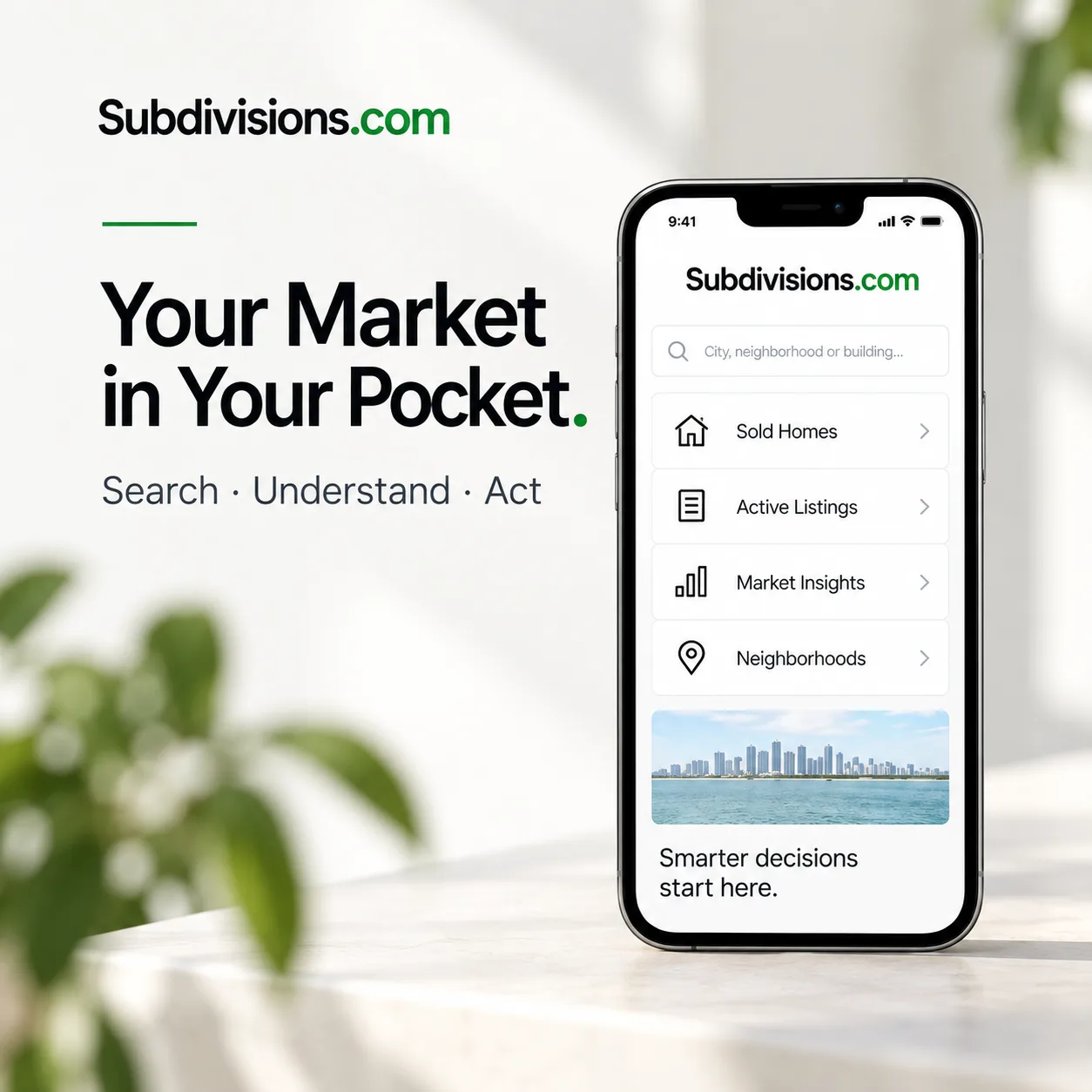
Subdivisions.com provides the persistent digital destination.
Email or text can communicate timely information to appropriate, opted-in relationships.
Social media can amplify selected insights and build a visible archive of the advisor's work.
And in-person conversations convert digital recognition into human familiarity.
The frequency should depend on the market.
A highly active waterfront building may generate meaningful developments frequently.
A thin single-family subdivision may not.
Consistency should not become a quota.
The better rule is:
The calendar can schedule the review. Only the market should justify the message.
This creates a different kind of personal brand
The advisor's brand should not disappear behind technology.
Quite the opposite.
The community is the subject.
Market intelligence is the value.
The advisor's name and perspective are the human connection.
Best of Luxury Realty provides professional brokerage infrastructure.
Subdivisions.com provides the homeowner-and-resident intelligence layer.
The result should feel like:
Your personal brand. Serious infrastructure behind it.
Over several years, an advisor can accumulate a genuine body of work around a residential market:
market briefings,
market signals,
annual reviews,
benchmark insights,
resident questions,
property-specific discussions,
and actual transaction experience.
That is a substantially more credible form of local authority than placing “community expert” under a headshot.
Starting local does not mean staying small
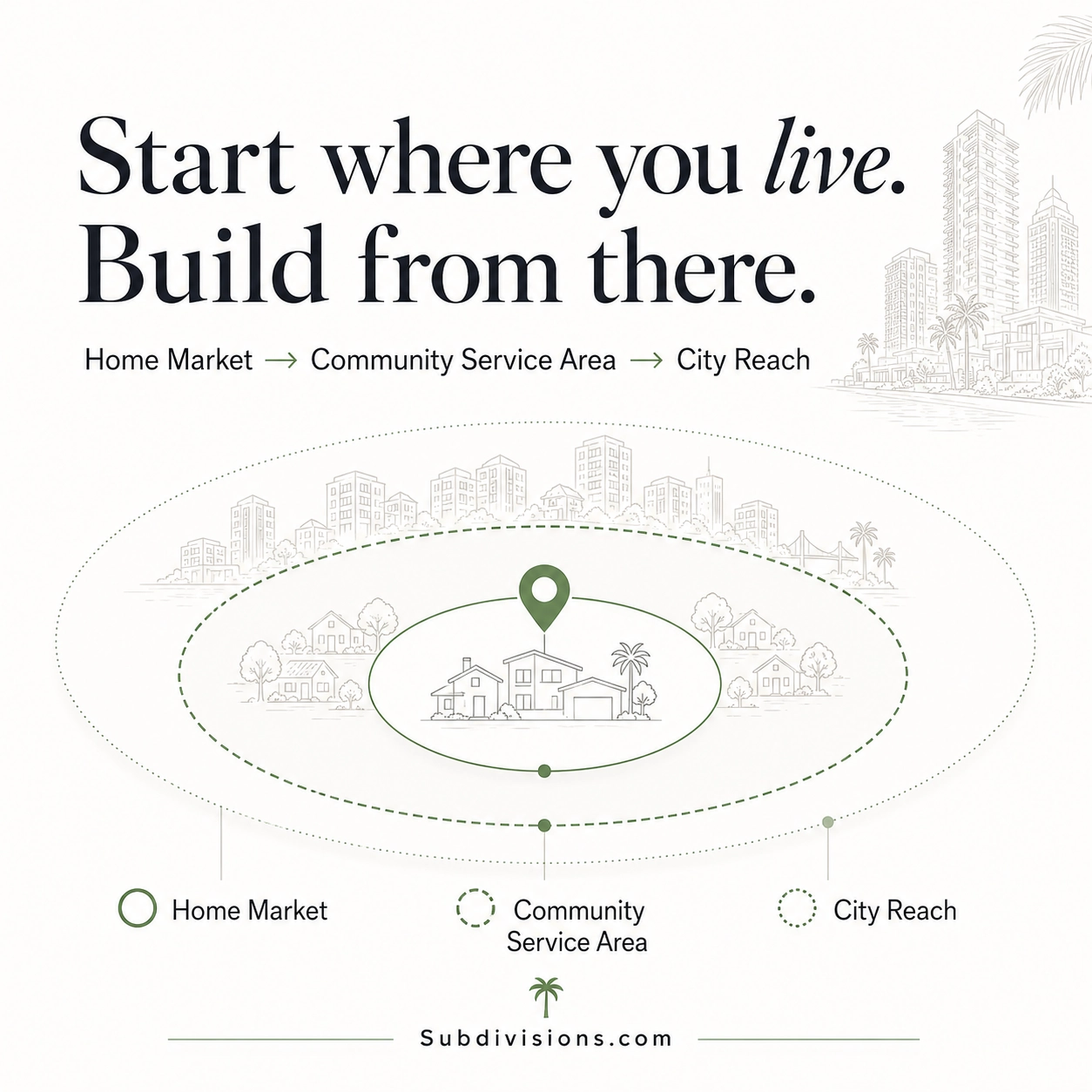
The Community Partner architecture begins with a Home Market — the residential community where the professional has a genuine local connection.
From there, the advisor can build a practical Community Service Area around nearby residential communities.
And beyond that remains normal City Reach: buyers, referrals, previous clients, organic relationships and broader professional business.
The model is:
Home Market → Community Service Area → City Reach
The objective is concentration, not confinement.
A useful way to describe the resulting advisor is:
Deep locally. Contextually informed citywide.
What does the professional actually gain?
This is ultimately the business question.
The value proposition is not simply access to another technology product.
A Community Partner can potentially use Subdivisions.com to prepare faster, understand markets more deeply, stay visible for legitimate reasons, improve seller conversations, connect their professional identity with persistent community information and build outward from a stronger local center.
Those professional objectives are already part of the Community Partner design.
But the larger asset is more interesting:
Recognition that compounds.
When a homeowner eventually needs an advisor, the professional may already be someone they recognize.
Someone whose information they have read.
Someone whose market updates they have seen.
Someone they have asked a question.
Someone their neighbor knows.
Someone visibly connected with understanding the market.
That is not the same as buying a lead.
It is building a position.
The larger idea
The Community Partner model is an experiment in a broader proposition:
What if the residential community itself became a persistent market-intelligence layer?
Subdivisions.com organizes and monitors that layer.
The Community Partner turns it into a human relationship.
Best of Luxury Realty provides the professional real estate service path when the consumer chooses to transact.
That combination matters because technology alone does not create relationships.
And relationships without useful information can struggle to remain relevant.
Putting the two together creates something more interesting:
Defined market. Relevant signal. Useful conversation.
And over time:
Useful conversation → Recognition → Local authority → Opportunity.
The future of local real estate may not belong to the professional who manages to reach the most people.
It may belong to the professional who becomes worth knowing in the market they know best.
Community Partner Opportunity
Serve where you live. Build from there.
The Community Partner Opportunity from Best of Luxury Realty and Subdivisions.com is designed for qualified real estate professionals who want to build deeper local market knowledge, stronger homeowner relationships and a more recognizable professional presence around the residential communities they serve.
Be known for knowing the market.
Comments