
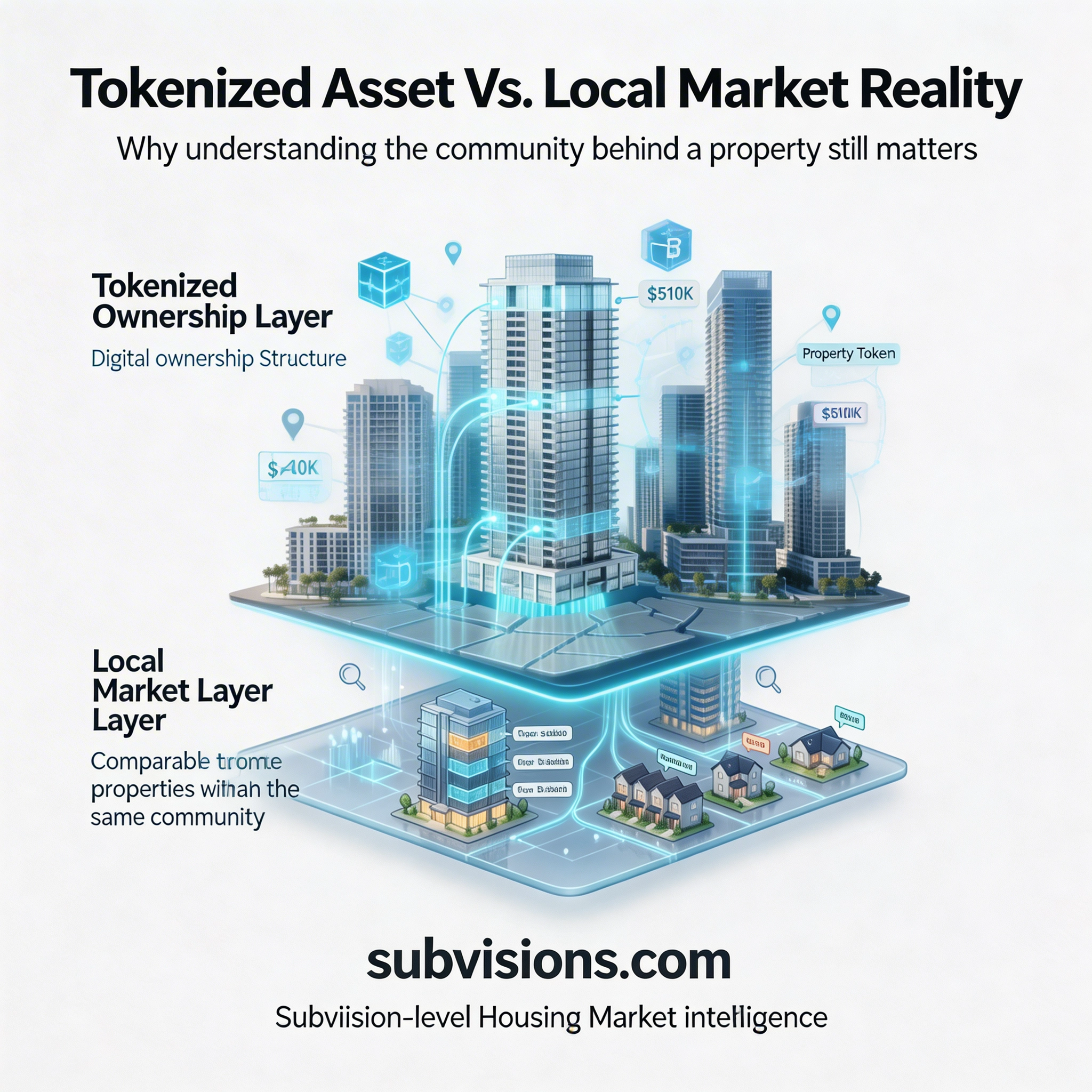

Real estate tokenization is quickly becoming one of the most talked-about ideas at the intersection of blockchain and property markets.
The premise is appealing. By representing ownership of real estate as digital tokens, properties can potentially be divided into fractional interests and traded more easily than traditional ownership structures allow. In theory, tokenization could make real estate more accessible, more liquid, and easier to distribute across global investor networks.
But beneath the innovation lies a fundamental question that tokenization alone does not solve:
How do investors determine whether the underlying property is actually worth its price?
Tokenization may change how real estate ownership is structured.
It does not change how real estate value is determined.
Real Estate Is Still Valued Locally
Unlike many digital assets that trade within global markets, residential real estate remains deeply local.
Property values are typically established through comparisons with similar homes nearby—what real estate professionals call comparable properties or “comps.”
For example:
A condominium unit is usually compared with other units in the same building.
A townhome is evaluated against similar homes in the same development.
A single-family house is typically compared with homes in the same residential community.
These comparable homes form what professionals call a competitive set.
And in residential real estate, those competitive sets almost always exist within specific communities.
The Role of Residential Communities in Price Discovery
Most housing markets are not uniform across an entire city or ZIP code.
Instead, they are composed of many smaller residential environments—condominium buildings, townhome developments, and planned single-family communities.
In real estate terminology, these communities are often referred to as subdivisions.
Homes within the same subdivision typically share several characteristics:
similar construction periods
comparable floor plans and square footage
consistent architectural design
shared amenities and homeowners associations
similar buyer demand
Because of these similarities, homes in the same community tend to compete directly with one another in the market.
For this reason, pricing comparisons are usually most meaningful within the same residential community.
A Key Challenge for Tokenized Real Estate Investors
Tokenization has the potential to allow investors to participate in real estate opportunities across cities, regions, or even countries.
But this broader access introduces a new challenge: many investors evaluating tokenized properties may have limited familiarity with the local housing markets where those assets exist.
Without local market context, it becomes difficult to answer questions such as:
How do similar homes in the same community compare in price?
What recent transactions have occurred within the development?
How does supply and demand behave within that specific residential area?
These factors can significantly influence how a property performs as an investment.
For tokenized real estate markets to function efficiently, investors still need ways to understand the local competitive environment surrounding the property.
The Importance of Community-Level Market Data
Much of the public real estate information available online is organized around individual property listings or large geographic areas such as cities or ZIP codes.
While this structure can help users discover properties, it may not always provide a clear view of how a specific residential community is performing.
Organizing housing activity around subdivisions and residential communities can provide a more structured perspective on local markets.
Instead of viewing properties as isolated listings scattered across a city, analysts can evaluate housing activity within the communities where comparable homes actually compete.
Platforms such as Subdivisions.com focus on structuring housing data at this community level, helping organize real estate activity around residential developments rather than treating properties as disconnected listings.
For investors analyzing residential real estate—including those exploring tokenized property opportunities—this type of local market context can provide additional insight into how an asset fits within its surrounding housing ecosystem.
Technology Evolves. Markets Still Matter.
Blockchain technology may introduce new models for ownership, financing, and trading real estate assets.
But the underlying property remains part of a local housing market shaped by comparable homes, community characteristics, and neighborhood dynamics.
Tokenization may change how real estate is packaged and traded.
Understanding its value, however, still depends on something far more traditional:
Because no matter how a property is owned—directly, through a fund, or through digital tokens—it still exists within a community where homes compete, buyers make decisions, and prices are ultimately discovered.
Comments