
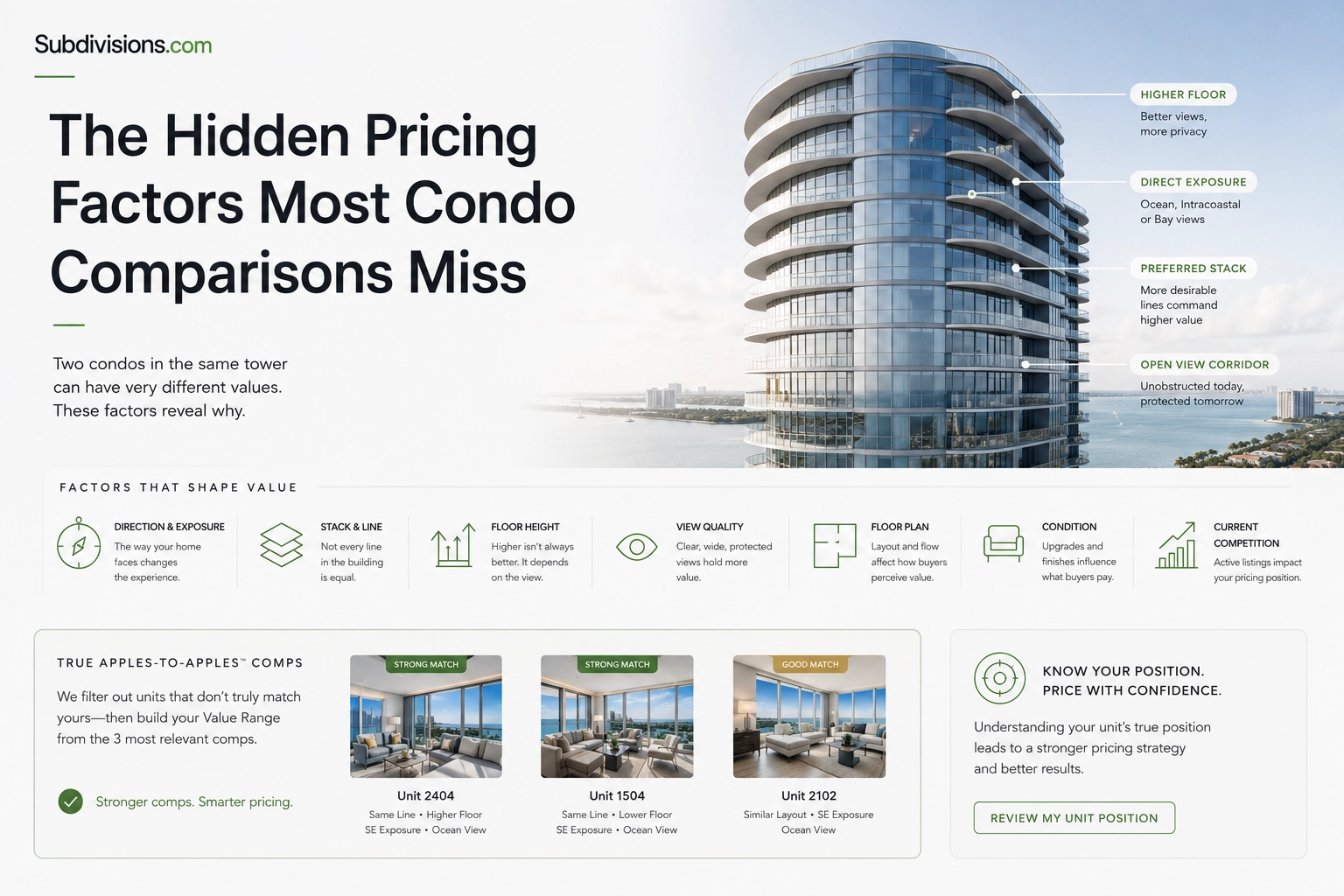

Two condominium residences can be located in the same tower, have the same number of bedrooms, and contain nearly identical square footage—yet attract meaningfully different prices.
That is especially true in Miami’s waterfront high-rises, where a unit’s relationship to the building, water, skyline, and surrounding development can influence how buyers perceive it.
Most owners understand this intuitively. They know that a direct ocean view is different from a partial water view. They know that one line in the building may be more desirable than another. They know that a higher floor can be valuable—but only when it creates a better experience.
The problem is that many conventional condo comparisons do not capture these distinctions precisely enough.
They often begin with the obvious characteristics:
same building;
similar square footage;
same bedroom count;
recent sale date;
similar price per square foot.
Those are useful starting points, but they do not automatically make two residences true comparables.
A Comparable Sale Is Not Necessarily a Relevant Comparable
The purpose of a comparable sale is not simply to find a recently sold property. It is to find the strongest available evidence of how buyers may respond to the subject residence.
Professional appraisal guidance recognizes this distinction. The most recent sale is not always the best comparable when an older sale requires fewer and more supportable adjustments. Comparable selection should be based on relevance, not recency alone. (Selling Guide)
In a single-family neighborhood, two nearby homes may differ in lot size, condition, architecture, or location within the community.
Inside a waterfront condo tower, the differences can be more vertical and directional:
floor;
line or stack;
direction;
exposure;
view corridor;
corner or interior position;
balcony configuration;
floor plan;
surrounding obstructions.
A sale elsewhere in the tower may look comparable in a spreadsheet while offering a substantially different living experience.
1. Direction and Exposure
Direction describes where a residence faces. Exposure describes what that orientation allows the resident to experience.
They are related, but they are not identical.
A southeast-facing unit may receive morning light and open-water views. A west-facing residence may offer sunsets and skyline views. A north-facing unit may receive softer natural light, while a southern exposure may receive stronger sunlight during parts of the day.
Neither direction is automatically superior in every building. Its value depends on:
the tower’s location;
the surrounding skyline;
the water orientation;
nearby buildings;
the floor;
buyer preferences;
the durability of the view.
Research into high-rise housing describes view as an intra-building characteristic shaped by orientation, floor level, building spacing, surrounding massing, and waterfront or skyline position. In other words, the value of a view cannot always be separated from where the unit sits inside the tower. (MDPI)
This is why comparing two units solely because they share a bedroom count can create a false equivalence.
2. The Unit Line or Stack
In many condo towers, residences directly above and below one another belong to the same architectural line or stack.
These units may share:
a similar floor plan;
the same exterior orientation;
comparable balcony placement;
similar window locations;
the same general view corridor.
That often makes a same-line sale a particularly useful starting point.
But even units in the same line are not automatically identical.
A higher-floor residence may clear a neighboring structure. A lower-floor residence may have a closer relationship to the water. Mechanical floors, podiums, amenity decks, landscaping, roadway noise, and nearby construction may also affect the experience.
The right question is therefore not:
Did another unit in this line sell?
It is:
How closely did that unit match the subject residence at the time of sale?
3. Floor Height
Higher floors are commonly assumed to be more valuable, but the relationship is not always linear.
A move from the eighth floor to the fifteenth floor may dramatically improve a view if the higher residence clears an obstruction. A move from the thirty-fifth to the thirty-eighth floor may produce little practical difference when both already have fully open exposure.
Floor height can influence:
privacy;
noise;
light;
view reach;
water visibility;
skyline visibility;
perceived prestige;
wind conditions;
connection to the surroundings.
The relevant factor is not simply the floor number. It is what changes because of the floor.
A unit ten floors higher should not receive an automatic premium without evidence that buyers have historically paid for the resulting difference.
4. View Quality
Listing descriptions often reduce views to broad labels such as:
ocean view;
water view;
city view;
intracoastal view.
Those labels can hide major differences.
A water view may be:
direct;
panoramic;
angled;
partial;
seasonal;
framed between buildings;
visible only from the balcony;
vulnerable to future obstruction.
Researchers studying high-rise valuation have noted that view quality is frequently handled informally or embedded implicitly in sale prices, making comparisons less transparent. Their findings support treating views as measurable property characteristics rather than decorative listing language. (MDPI)
For Miami waterfront owners, this distinction matters. Buyers are not simply purchasing the existence of water somewhere in sight. They are purchasing a particular relationship with it.
5. The Floor Plan
Two residences can have similar square footage but function very differently.
The distribution of that space may affect:
room proportions;
natural light;
privacy;
circulation;
usable wall space;
bedroom separation;
kitchen openness;
balcony access;
water views from primary rooms.
Academic research has found that floor-plan design can add explanatory power to property-pricing models beyond conventional structured variables. One study reported lower out-of-sample prediction error when floor-plan information was incorporated into the model. (arXiv)
The practical lesson is straightforward:
Square footage measures how much space exists. It does not fully describe how that space lives.
6. Corner Versus Interior Position
Corner residences often provide additional windows, multiple exposures, greater separation from adjacent units, or wider views.
But “corner unit” should not be treated as an automatic price adjustment.
Its value depends on what the corner creates:
a second meaningful exposure;
improved light;
greater privacy;
a wraparound balcony;
a superior layout;
a broader water or skyline view.
A corner that faces a neighboring tower may not receive the same market response as a corner with open water on two sides.
The physical feature matters less than the experience it produces.
7. Interior Condition
Even a nearly perfect structural comparable may require interpretation when the residences differ materially in condition.
Buyers may respond differently to:
original versus renovated interiors;
renovation quality;
kitchen and bathroom finishes;
flooring;
millwork;
lighting;
smart-home systems;
window treatments;
furnishings;
deferred maintenance.
Renovation costs do not necessarily translate dollar for dollar into resale value. Taste, age, craftsmanship, and buyer expectations within the building also matter.
This is one reason unit-level pricing should combine data with direct property review.
8. Current Competition
Closed sales explain what buyers previously accepted. Active listings reveal the choices buyers are evaluating now.
A homeowner may have three strong historical comparables, but the recommended pricing strategy can still change when:
several similar units are already listed;
a competing unit has recently reduced its price;
one residence is fully renovated;
another has a more desirable exposure;
buyers have multiple alternatives in the same building.
Active listings should not be treated as completed evidence of value because they have not sold. But they are important evidence of competitive position.
Pending sales may provide an additional signal, although their final terms generally remain unknown until closing.
A complete analysis therefore separates:
Closed True Comps
Evidence of what buyers have actually paid.
Active Competition
Evidence of what current buyers can choose instead.
Mixing the two can create confusion. Showing them side by side creates context.
Why Price per Square Foot Is Not Enough
Price per square foot is useful for orientation, but it should not become a shortcut for valuation.
It compresses every difference into one number.
Two units can have the same interior area while differing in:
exposure;
floor;
view;
terrace utility;
condition;
layout;
privacy;
competitive timing.
The metric tells us what a buyer paid relative to size. It does not tell us why.
A price-per-square-foot comparison becomes more meaningful only after the comparable residences have been properly selected.
Fewer, Stronger Comps Can Be More Useful
A long list of building sales may appear more authoritative than a short list. But adding weak comparisons can dilute the analysis.
Three highly relevant sales may provide more useful evidence than fifteen transactions that require major assumptions.
A stronger process should:
begin within the same condo tower;
identify the subject unit’s physical position;
compare line, floor, direction, exposure, view, layout, and size;
filter out materially different residences;
separate closed evidence from active competition;
show why each comparable was included;
acknowledge when the available evidence is limited.
This is the principle behind True Apples-to-Apples™ Comps.
What Makes a Comp “True”?
“True” does not mean that two residences are perfectly identical. That is rarely possible.
It means the comparison has been tested for meaningful relevance.
For a Miami waterfront condominium, that may include:
the same tower;
the same or comparable line;
similar direction and exposure;
a similar view relationship;
a relevant floor band;
a comparable floor plan;
similar interior area;
recent market timing.
The goal is not to produce the largest collection of sales.
The goal is to identify the sales buyers are most likely to use—consciously or unconsciously—when deciding what the subject residence is worth to them.
From Comparable Sales to a Value Range
No single past sale can fully determine the value of another residence.
The strongest relevant comparables should be considered together to establish an evidence-supported Value Range.
A range is more honest than a single automated number because the final result can still be affected by:
interior condition;
renovations;
assessments;
current inventory;
seller timing;
buyer demand;
presentation;
negotiation.
The Value Range provides market orientation. It helps an owner understand where the residence may be positioned before choosing a listing strategy.
That strategy may then prioritize one of several outcomes:
protecting a higher price expectation;
competing directly with current alternatives;
creating stronger early buyer attention;
balancing price with the desired selling timeline.
The Question Every Waterfront Condo Owner Should Ask
Before relying on a comparable sale, ask:
What does this residence truly share with mine besides its address, bedroom count, and square footage?
That question can reveal whether the sale belongs in the analysis—or merely happened in the same building.
For Miami waterfront homeowners, accurate pricing begins by understanding that a condo is not simply a unit inside a tower.
It is a specific position within that tower.
Its direction, exposure, floor, line, view, layout, condition, and competition all shape how buyers experience it.
The better those factors are understood, the more useful the comparisons become—and the more confidently an owner can approach the market.
Understand Your Unit’s Position Before You List
Subdivisions.com uses True Apples-to-Apples™ Comps to identify the residences most relevant to your unit and build an evidence-supported Value Range.
A Best of Luxury Realty waterfront condo advisor can then review your property’s condition, current competition, selling timeline, and pricing strategy.

Comments