
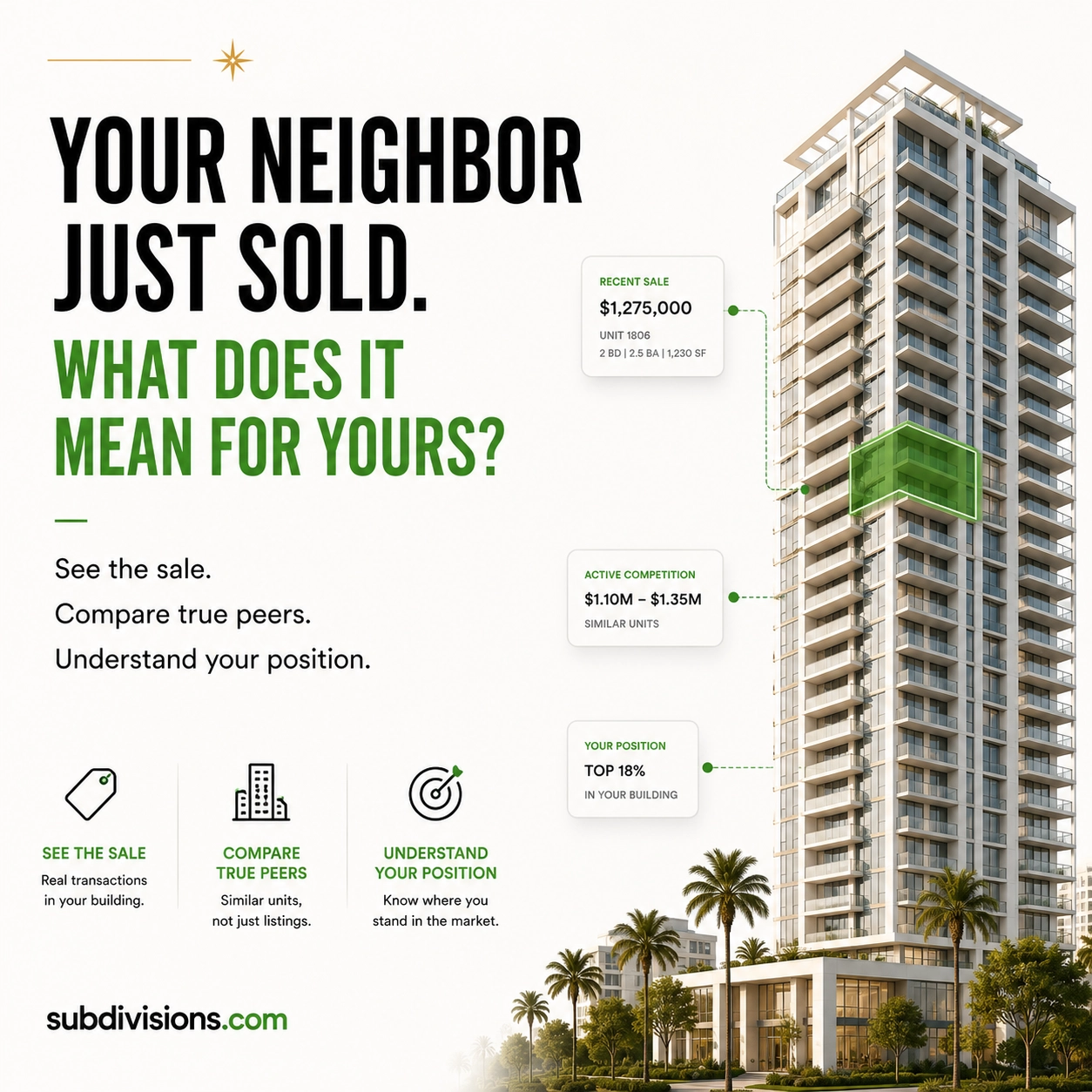

You probably know your home better than anyone. You know which room gets the best morning light, what has been renovated, what still needs attention, and what makes your particular residence different from the one next door. But do you know what is happening in the market around it?
Which properties are competing with yours today? Which recent sales actually deserve comparison? How quickly are similar homes selling? Is inventory building or shrinking? And if you wanted more space — or less — what would that move look like without necessarily leaving the community you already love?
For most homeowners, these questions become urgent only when they start thinking about selling. We think they should be easier to answer before that moment arrives. That is the idea behind Subdivisions.com.
The traditional real estate experience is heavily transaction-driven. Search when you want to buy. Call an agent when you want to sell. Order an appraisal when someone needs a formal valuation. In between those events, many homeowners have surprisingly little structured information about the market immediately surrounding one of their largest assets.
The industry is beginning to recognize that gap. Realtor.com has expanded its homeowner tools around questions such as whether to sell, rent, renovate or use accumulated equity. Redfin gives homeowners value tracking, nearby-sale updates and the ability to select recently sold properties for an Owner Estimate. Zillow's Zestimate remains a widely available automated starting point for understanding potential home value.
These are useful developments. But there is another question we believe deserves more attention: what is the market that actually surrounds your property?
A ZIP code can contain thousands of homes that have little practical relationship to one another. A radius can cross different condominium buildings, gated communities, waterfront locations, school boundaries, housing types and product classes. Even inside one condominium tower, two residences can differ meaningfully because of floor, line, exposure, view, layout, condition or renovations.
Real estate is local. But sometimes even “local” is too broad.
That is why Subdivisions.com starts with the residential community and then works toward the property. The platform is organized around condominium buildings, subdivisions, townhome and villa communities, gated developments and other defined residential markets.
The objective is not simply to tell you that a property exists or place another automated number beside its address. It is to help answer more useful questions. What is for sale now? What recently sold? What appears to be genuinely relevant to my property? How is inventory changing? How quickly is the market moving? Where does my property appear to sit relative to current competition? What changed since the last time I looked?
That distinction matters because data and market intelligence are not the same thing. More data does not automatically create more understanding. The information has to be organized around the decision.
Homeowners naturally look backward when thinking about value: “What did my neighbor sell for?” It is an important question, but it is not the only one. If you were entering the market today, a buyer would not be choosing between your home and a property that sold six months ago. The buyer would also be looking at what is available right now.
That is why we emphasize Active Competition alongside relevant closed-market evidence. A recent sale helps explain what the market accepted. An active listing helps explain what today's buyer can choose instead. Both belong in the conversation.
Automated valuations have also made approximate property values readily accessible to consumers. But Subdivisions.com approaches the problem from another direction. Before asking what a property may be worth, we ask what the property should actually be compared with.
That is the purpose behind True Apples-to-Apples™. Depending on the property type, relevant comparison may involve the same community, building, floor range, stack or line, exposure, view, layout, size and other characteristics that influence how buyers perceive competing homes.
The goal is not to find the greatest number of comparables. It is to find the most relevant ones available.
This becomes especially useful for residents who love where they live but whose needs have changed. Not every homeowner who needs a different home wants a different lifestyle. You may love the building but need another bedroom. You may want to stay near the same neighbors but no longer need as much space. You may want a better view, a different floor plan, less maintenance or simply a residence that better fits the next stage of life.
A housing decision does not always mean starting over somewhere else. Sometimes it means right-sizing within a place you already know.
That is where community-level intelligence becomes particularly useful. Instead of starting a broad home search from scratch, a resident should be able to understand what is available within the community, what larger or smaller residences have recently traded, what their current home would compete against if sold, and whether there is a realistic path from one residence into another nearby.
Those are homeowner questions, not merely listing-search questions.
We also believe a residential community can be a market worth monitoring. Investors monitor portfolios. Companies monitor competitors. Consumers track mortgage rates, stocks and retirement accounts. Yet homeowners often receive very little ongoing intelligence about what is changing immediately around their property.
Subdivision Monitor is being built around that idea. A new competing property comes to market. A relevant residence sells. Inventory changes. Pricing moves. Market speed shifts. A potentially interesting larger or smaller home appears.
These events may not mean you should do anything. They may simply mean you should know.
There is a significant difference between being informed and being ready to transact. Homeowners deserve room for both.
Subdivisions.com is also not simply another automated valuation tool. There is already a sophisticated real estate data industry serving lenders, institutional investors, agents and financial companies. Platforms such as HouseCanary provide valuations, forecasts, comparable analysis, portfolio monitoring and market analytics for professional users.
Subdivisions.com occupies a different position. We are taking the idea of real estate market intelligence and making it useful at the level where homeowners and residents actually experience real estate: their property and their residential community.
Not only, “What is my home worth?” but “Where does my home stand?”
Not only, “What sold nearby?” but “What actually compares?”
Not only, “What is the ZIP-code trend?” but “What is changing inside my market?”
And not only, “Should I sell?” but “What are my options if I stay, sell, upsize, downsize or simply keep watching?”
That is the distinction we are building around.
A homeowner may be years away from selling. A resident may simply be curious. Someone may be waiting for the right larger residence to appear in the same building. Another owner may be thinking about downsizing but unwilling to leave the community. Someone else may simply want to understand whether the market around their home is becoming stronger, slower or more competitive.
Those are legitimate real estate needs even when there is no transaction attached to them.
Subdivisions.com is designed to make that period between transactions more useful. Some market information is available directly through the platform, while advanced decision-support products, including True Apples-to-Apples™ comparable analysis and Subdivision Monitor, are available separately.
Meaningful market intelligence has value even when no one is asking you to list your home.
And when the time does come to sell, data still does not make the decision for you. Market intelligence cannot see every renovation, understand every seller objective, negotiate with a buyer or determine how a particular property should ultimately be presented.
That is where professional judgment belongs.
Subdivisions.com can help organize the evidence before the conversation begins. A capable real estate professional can then interpret that evidence in the context of the property, the seller and the transaction.
We believe those two layers should complement one another: Market Intelligence → Decision Support → Professional Judgment → Execution.
Most days, your home is not a listing. It is where you live.
And if you love where you live, the next real estate decision may not be about leaving at all. It may be about moving three floors higher, finding another bedroom, trading maintenance for simplicity, moving into a different residence within the same community, or doing absolutely nothing while understanding the market well enough to recognize an opportunity when one appears.
That is the homeowner relationship with real estate we want to make possible.
Not just search. Not just valuation. Not just a transaction.
Ongoing market understanding, community by community.
Subdivisions.com
Know where your home stands.

Comments