

Finding a home online has never been easier.
A single search on a national real estate portal can reveal hundreds of listings across a city or ZIP code. Buyers can browse photos, compare square footage, and view property details within seconds.
But once a buyer finds a home that looks appealing, the most important question immediately follows:
Is the price actually fair?
Is the property reasonably priced compared to similar homes?
Is it overpriced?
Or could it be a good opportunity?
For most consumers, answering that question is far more difficult than finding the listing itself.
The Hidden Problem With Listing-Centric Real Estate Search
Most national real estate portals are designed around individual property listings.
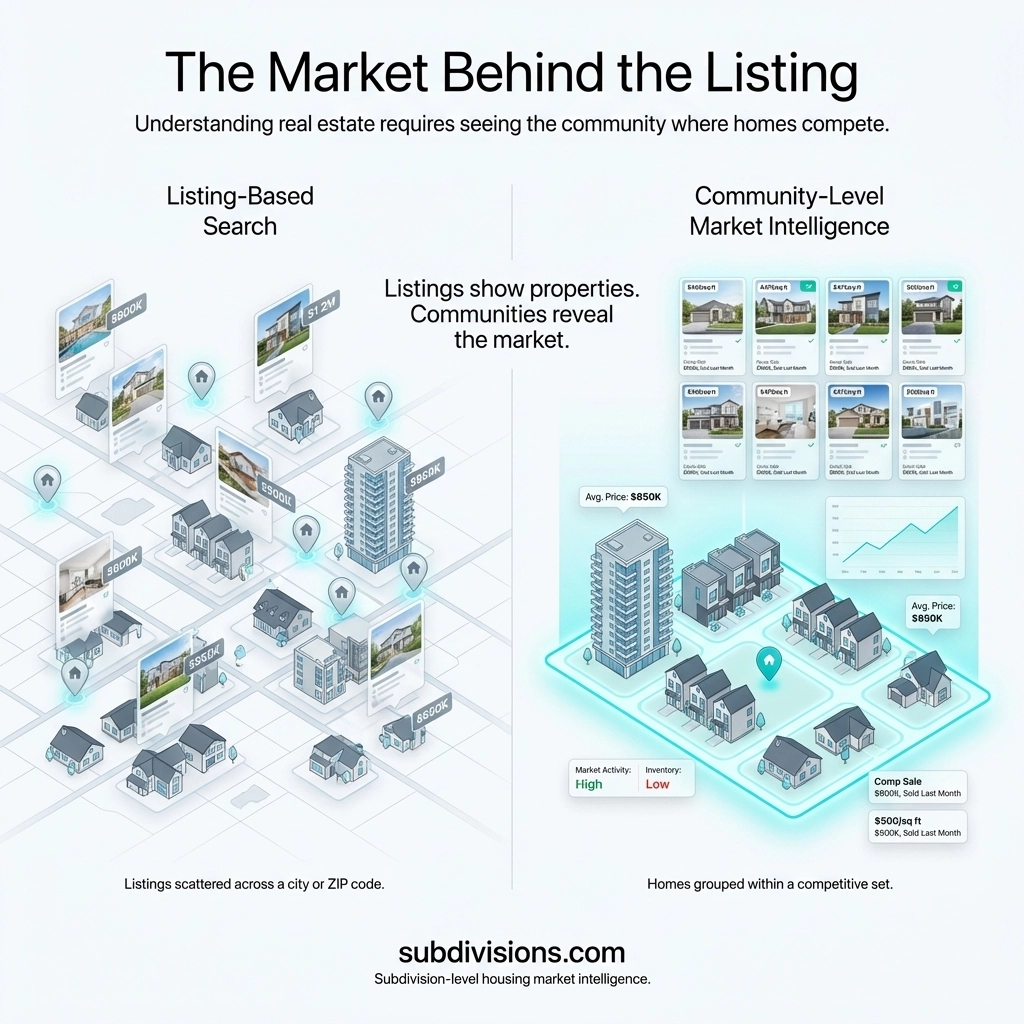
When someone searches for homes within a city or ZIP code, the results typically display properties scattered across the area. A condominium unit in one building may appear next to a house in a different neighborhood or a townhome development several miles away.
These listings may technically fall within the same city or ZIP code, but they often belong to very different housing environments with different pricing dynamics.
As a result, the search results can appear as a mixed stream of properties rather than a structured market view.
For a consumer trying to determine whether a property is fairly priced, this structure presents a challenge.
The buyer must manually filter through listings spread across a city to locate homes that truly belong to the same residential community and competitive market.
Why Comparable Homes Are Usually Found Within the Same Community
In real estate, properties are typically evaluated within what professionals call a competitive set.
A competitive set consists of homes that share similar characteristics, such as:
comparable home sizes and layouts
similar construction periods
the same homeowners association
shared amenities such as pools, gyms, or security
consistent architectural design
similar buyer demand
These comparable homes are most often located within the same residential community.
In real estate terminology, these communities are known as subdivisions.
A subdivision may be a condominium building, a townhome development, or a single-family home neighborhood.
Within these communities, homes tend to share similar characteristics and compete directly with one another.
Because of this, subdivisions naturally form housing micro-markets.
Why Price Context Is Difficult to See on Listing Feeds
When listings from multiple communities appear together in a single feed, the context needed to evaluate price can become difficult to see.
Two homes may appear similar on a search page but belong to communities with very different pricing patterns.
For example, two condominium units may share similar square footage but be located in buildings with different amenities, maintenance structures, or construction quality.
Likewise, two single-family homes may be located in adjacent neighborhoods but belong to different residential developments with distinct pricing histories.
Without seeing the full competitive set within the same community, it becomes much harder for consumers to determine whether a listing represents a fair market value.
Viewing the Housing Market Through Communities
When homes are organized within their residential community, the market becomes easier to understand.
Instead of viewing isolated listings scattered across a city, buyers can evaluate properties within the community where those homes actually compete.
This allows consumers to quickly see:
what similar homes within the community are selling for
recent sales within the same development or building
how prices compare within the competitive set
whether a listing appears aligned with local market activity
Rather than piecing together scattered information from multiple listings, buyers can view the housing market within the community itself.
Why Local Residents Often Start With a Community
For many homeowners, renters, and buyers, housing decisions often begin with a community they already recognize.
It may be a condominium building they pass every day on their commute, a residential development where friends live, or a neighborhood community they have become familiar with over time.
These places often become the reference points people use when imagining where they might live.
When the search becomes serious, many consumers naturally want to understand what is happening within that specific community.
Seeing the Market Behind the Listing
A listing shows that a property is available.
But determining whether that listing represents a fair opportunity requires understanding the market behind that property.
In real estate, that market is often defined not by the city or ZIP code, but by the residential community where homes share characteristics and compete directly with one another.
Understanding the housing market at the community level helps transform a listing from a simple advertisement into a data point within a competitive market.
And that context can make all the difference when answering the question every buyer eventually asks:
Is this home priced fairly?
Key Insight
The hardest part of buying a home is often not finding the property.
It is understanding the market that surrounds it.
And in many cases, that market exists within the residential community where comparable homes truly compete.

Comments