
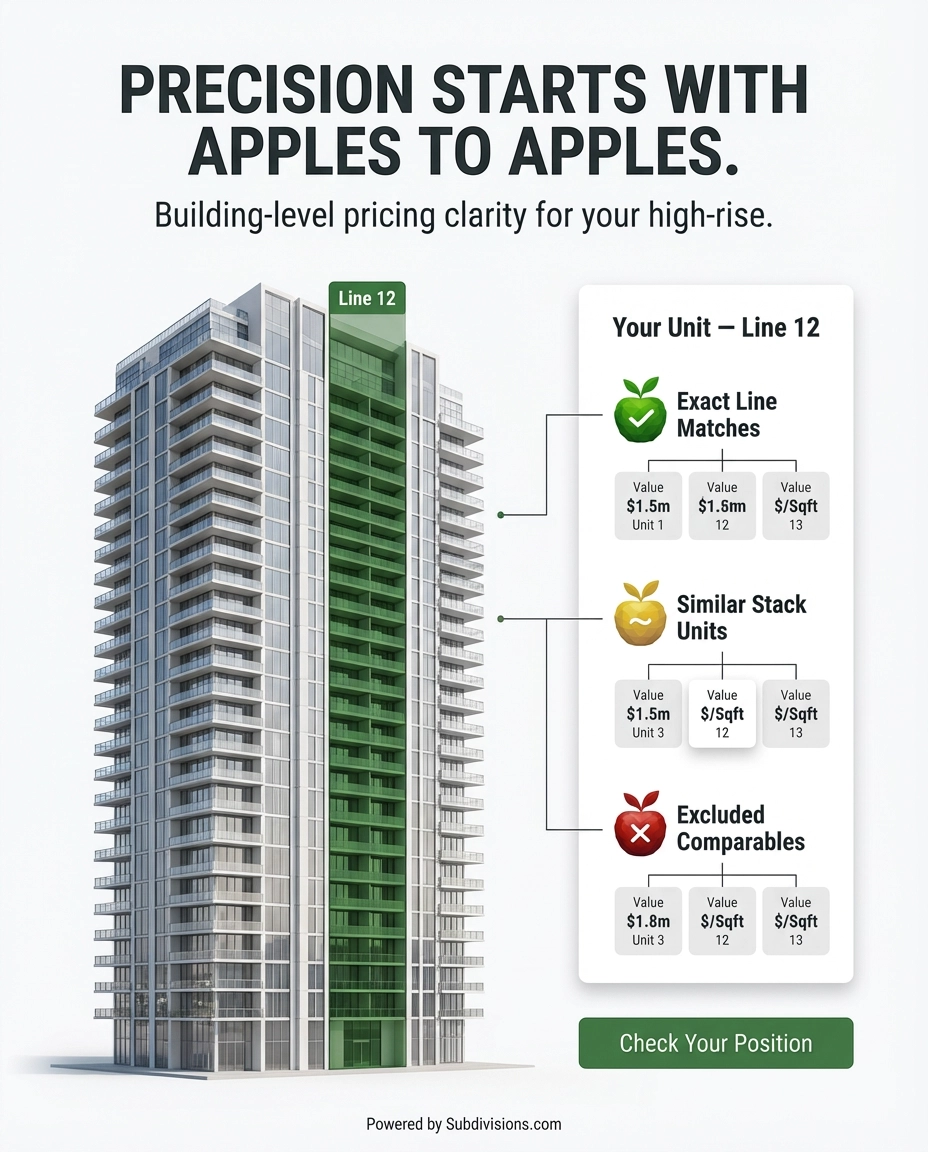

Institutional participation in residential real estate — particularly in high-rise condominium markets — continues to expand across South Florida.
Developers managing remaining inventory, private equity groups holding condo units, BPO firms supporting lenders, and asset managers overseeing portfolio exposure all face a common operational challenge:
Pricing consistency.
Not in theory — in workflow.
When multiple analysts, brokers, or managers are evaluating units inside dense vertical towers, comp selection variability and stack-level nuance can introduce incremental pricing drift.
At portfolio scale, incremental drift becomes operational friction.
The Comp Standardization Problem in High-Rise Markets
Most residential comp workflows rely on:
• Building-level filters
• Square footage similarity
• Recent sale date proximity
• Discretionary floor or view adjustments
In single-family environments, this approach is typically sufficient.
In high-rise environments, it is structurally incomplete.
Within a single tower:
• Different stacks may perform differently
• Floor tiers may not scale linearly
• Active competition inside the same line impacts absorption
• Identical layouts can experience different velocity
When comparables are aggregated across the building rather than isolated vertically by stack, comp selection becomes partially subjective.
Subjectivity introduces variability.
Variability reduces standardization.
For institutions, comp standardization is not cosmetic — it supports internal defensibility.
Why Internal Defensibility Matters
In institutional contexts, pricing decisions must withstand:
• Investment committee review
• Credit committee scrutiny
• Internal audit processes
• Lender oversight
• Portfolio reporting
When comp methodology varies across analysts or transactions, internal alignment becomes harder to maintain.
Common friction points include:
• Inconsistent floor adjustments
• Different interpretations of active competition
• Misalignment between list price and recent sale distribution
• Repricing cycles following extended days on market
None of these are catastrophic individually.
Across multiple units, they erode pricing discipline.
BPO Workflow Efficiency in Dense Condo Markets
Broker Price Opinions and internal valuation reviews in high-rise markets often operate under time constraints.
Analysts must quickly:
• Identify relevant comps
• Isolate similar units
• Evaluate active competition
• Produce defensible pricing ranges
When stack-level context is not clearly structured, analysts may rely on broader building-level aggregation.
This increases:
• Manual comp sorting time
• Variability between analysts
• Revision requests
• Internal review cycles
Improving BPO workflow efficiency in vertical markets requires better organization of data — not necessarily more data.
Portfolio Alignment and Inventory Pricing Discipline
For developers and institutional condo holders, pricing discipline across multiple units inside the same building is critical.
Common portfolio challenges include:
• Internal competition between similar stacks
• Release schedule misalignment
• Over-aggregation across vertical lines
• Inconsistent pricing tiers
At $1M+ average unit values, even small pricing inconsistencies compound across inventory.
A 3–5% variance may appear negligible at the unit level.
Across 20 units, it becomes material.
Portfolio alignment improves when pricing is structured vertically rather than aggregated horizontally.
The Role of Structured Building-Level Intelligence
Improving comp standardization and pricing discipline in high-rise residential assets requires isolating how pricing actually competes:
Inside the building.
This means organizing market data by:
• Stack (line)
• Floor tier
• Active vs. sold alignment within identical lines
• Intra-building pricing distribution
Rather than replacing appraisal methodology or producing valuation conclusions, structured building-level intelligence supports:
• Faster comp identification
• Reduced analyst variability
• Clearer internal pricing rationale
• Improved defensibility
It provides context.
Professionals still apply judgment.
But judgment operates within a cleaner framework.
Subdivisions.com: Supporting Pricing Consistency in Vertical Markets
Subdivisions.com structures residential data at the subdivision and building level, with vertical stack alignment as a core organizing principle.
In high-rise markets, this allows users to:
• Isolate comparables line-by-line
• Visualize pricing distribution within a single tower
• Align active and sold competition
• Reduce comp selection noise
It is not an automated valuation model.
It does not issue value opinions.
It supports pricing workflows by improving how market data is organized.
For institutions focused on comp standardization, BPO workflow efficiency, portfolio alignment, and internal defensibility, structured organization reduces friction where it most often appears — at the comp selection stage.
Positioning and Credibility
Institutional demand for improved pricing discipline already exists.
What varies is the structure supporting it.
In high-rise residential assets — particularly in South Florida’s dense condo markets — horizontal aggregation is no longer sufficient.
Vertical organization improves:
• Pricing consistency
• Workflow speed
• Internal review clarity
• Capital alignment
The challenge is not demand.
It is building infrastructure that reflects how high-rise markets actually behave.
Subdivisions.com operates at that structural layer — inside the building — where pricing decisions are most sensitive.

Comments