
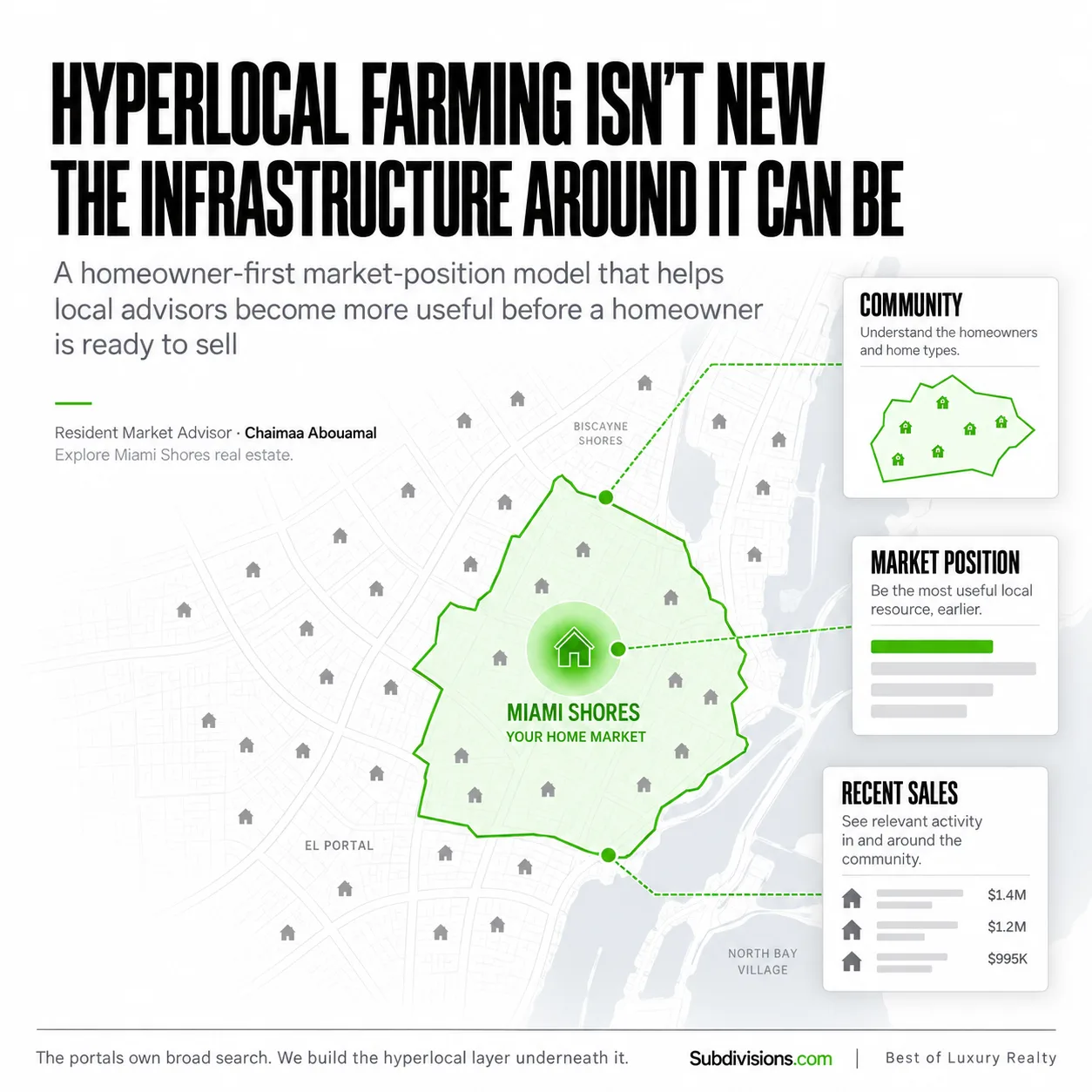

Real estate professionals have been farming neighborhoods, condo buildings and residential communities for decades. That part is not new, and there is no reason to pretend it is. Strong local agents have always understood the value of choosing a defined market, learning the inventory, following recent sales, building homeowner relationships and becoming recognizable over time.
The more interesting question is what infrastructure sits behind that effort.
For years, many agents have felt they needed a personal website because every serious professional was expected to have one. A website was launched, listings were connected, a biography was added, and perhaps a few community pages were created. But for many individual agents, the site generated little organic traffic, few inquiries and almost no meaningful search visibility.
That is not necessarily because the website was badly designed. The larger problem is the competitive environment around it.
Broad real estate search is dominated by national portals, large brokerages and companies with enormous technology, content and marketing budgets. An individual agent trying to rank a general website for a phrase such as “Miami real estate” is not simply competing with the agent across town. They are competing with Zillow, Realtor.com, Redfin, Homes.com, national franchise networks, major local brokerages and other established real estate publishers.
For an individual professional, that can be an extremely difficult place to build meaningful organic visibility.
Subdivisions.com approaches the problem one level deeper.
Rather than attempting to become another broad national search portal, the platform is building structured residential market infrastructure around the places where real estate becomes more specific: named subdivisions, residential communities, condo buildings, high-rise complexes, townhome communities and other defined residential markets.
That is where hyperlocal farming and digital market position begin to intersect.
An advisor may have little realistic opportunity to become highly visible for a broad phrase such as “Miami homes for sale.” But the competitive environment can change significantly when the search becomes more specific to a named residential community, building or subdivision.
That creates a more practical path for local professionals.
The goal is not to beat major portals at their own game. The goal is to build deeper market structure underneath them.
From an Agent Website to a Market Position
The difference is important.
A personal agent website is usually built around the professional. It introduces the agent, displays listings, describes services and asks the consumer to make contact.
A market-position model begins with the homeowner.
The first question is not, “How do we get someone to visit the agent’s website?”
The better question is, “What information would a homeowner actually want before they are ready to call an agent?”
That can include current competition, recent sales, pending activity, inventory levels, selling speed, market supply and the way one home is positioned against others in the same residential community.
Subdivisions.com is designed to organize that information around the market itself.
The advisor then becomes connected to that useful infrastructure as the local professional who follows it, interprets it and can help when the homeowner wants to go deeper.
That changes the relationship.
Instead of every interaction saying, “Thinking about selling? Call me,” the advisor can say, “Here is what is happening in your market.”
That is a better reason for the relationship to begin.
Why Local Residency Matters
Residency alone does not make someone a great real estate professional, and it should never be presented that way.
But it can create a meaningful starting advantage.
One of the recurring frustrations consumers express about real estate representation is the experience of working with someone who knows less about the immediate market than the buyer or seller does. That is particularly noticeable today because consumers have access to more property information than ever before. Buyers arrive with saved listings, recent sales, maps, school information and neighborhood research already in hand.
The professional has to add something beyond access.
Current consumer research supports that point. Zillow’s 2024 seller study found that 75% of sellers who used an agent considered local or neighborhood-specific knowledge highly important, while 75% also valued a positive reputation in the community. Trustworthiness and responsiveness were even higher, at 80% each. Zillow
That matters because the consumer is not simply looking for someone who can open a door or sell a dream. They want someone who can explain the market with greater depth than they can get from a listing portal alone.
A professional who actually lives in the market has a natural reason to remain engaged with it. They experience the community as a resident, not only as a salesperson. They see changes as they happen. They may already know homeowners, streets, property patterns and local concerns. They have a reason to pay attention even when no transaction is immediately available.
Residency is therefore not proof of expertise. It is a foundation for accountability and sustained local attention.
The expertise still has to be demonstrated.
The advisor has to follow the market, understand the individual residential communities, monitor competition, interpret sales, communicate clearly and continue earning trust over time.
That is why the public role should not be “local expert” simply because someone lives there.
A better idea is Resident Market Advisor.
The message is more credible: this professional lives here, follows this market and is available to help people understand it.
Miami Shores as a Working Example
Miami Shores is one of the markets where this model is beginning to take shape.
Subdivisions.com organizes Miami Shores at both the city and residential-community level, allowing homeowners to move from a broad market view into the individual subdivisions and communities that may be more relevant to their property.
You can explore the current Miami Shores real estate market and browse Miami Shores residential communities and subdivisions.
Chaimaa Abouamal PA, a Miami Shores resident and Best of Luxury Realty professional, is participating in the pilot as the Resident Market Advisor for Miami Shores.
Her profile is intentionally built around something simple and defensible: she lives in the market, follows the market and has a reason to stay useful to homeowners there.
You can view Chaimaa Abouamal’s Resident Market Advisor profile. Her profile identifies Miami Shores as her primary focus market while preserving the broader South Florida practice she continues to maintain. Subdivisions
That distinction is important.
Miami Shores is where the shared Market Position effort is concentrated. It is not the geographic limit of her real estate business.
Homeowners Do Not Need Another Sales Pitch
A homeowner may not be ready to sell today.
That does not mean they are uninterested in their market.
They may want to know what a nearby home sold for. They may be wondering whether inventory is increasing. They may want to understand why one property sold quickly while another has been sitting. They may simply want to know whether their own property would compete differently today than it did a year ago.
Those are useful conversations long before a listing appointment exists.
The goal of the Market Position model is therefore not to force intent earlier.
It is to become relevant earlier.
If the advisor can consistently help answer the homeowner’s market questions, then the professional has a reason to remain connected before a transaction is imminent.
That can be much more durable than competing only for the moment when someone finally types “listing agent near me.”
The Infrastructure Should Be Useful Even Without the Agent
This point is critical.
The market infrastructure cannot exist only as an SEO device.
It has to provide practical value on its own.
A homeowner visiting a Subdivisions.com community page should be able to understand something about the market even if they never contact the advisor.
That might mean seeing active competition, recent sales, pending activity, inventory, selling speed or other community-level signals.
The advisor then adds what the platform cannot: judgment, property-specific context, presentation, renovations, seller objectives, negotiation dynamics and professional execution.
The technology provides structure.
The professional provides interpretation.
That division makes the model stronger than simply creating another set of thin landing pages designed to capture search traffic.
Why Search Visibility Matters
The digital side is becoming increasingly important because consumers now find real estate professionals in many different ways.
Zillow’s 2024 seller research found that 36% of sellers who used an agent first found that agent online, including through real estate websites, search engines and social platforms. Zillow
That means an agent’s local market position increasingly has to exist both offline and online.
The problem is that most individual agents are effectively invisible for broad search.
Subdivisions.com creates a different opportunity by organizing deeper layers of the market where search intent is more specific.
Instead of trying to compete only for:
Miami real estate
the opportunity may be around:
Miami Shores real estate
then deeper still:
Bay Lure homes for sale
Miami Shores Bay View real estate
or another named residential community.
As the search becomes more specific, the relationship between market structure and local professional authority becomes more meaningful.
The strategy is not to promise that every advisor will rank number one on Google.
That would be unrealistic.
The more credible objective is to create a stronger, more coherent digital footprint around the professional’s actual Home Market through community pages, advisor profiles, original commentary, reviews, local content and relevant links.
Over time, that gives both people and search systems more evidence connecting the professional to the place.
The Portals Own Broad Search. We Are Building the Hyperlocal Layer Underneath It
That may be the simplest way to explain the opportunity.
Major portals are exceptionally strong at broad property search.
Subdivisions.com is focused on the residential market layer beneath that.
The platform structures named markets.
Best of Luxury Realty provides the brokerage and professional-service layer.
The advisor provides local relationships, judgment and execution.
Together, the goal is not to create another generic real estate website.
It is to build a useful residential market position around a place the professional actually knows.
That is what makes the model potentially more valuable than simply giving an agent another website, CRM or marketing package.
The advisor is not being told to build everything alone.
The infrastructure is already being built around the market.
The professional plugs into it and contributes the human layer.
|---|---|---|
| Golf View Estates | Earleton Shores | Bay Lure |
| Biscayne River Heights | Mirror Lake | East Of Biscayne |
| Eveningside | Shoreland Heights | River Bay Park |
| El Portal | Golden Gate Park | Pasadena Park |
| Miami Shores Estates | Gold Crest | Navarro |
| Dunnings Miami Shores | Odell Manors | West Shores |
| Harbour Club Villas | Shores Plaza West | Shores Villas |
| The Shores | Shores Plaza East | |
A Local Authority Has to Earn the Word “Local”
There is also a broader industry lesson here.
Consumers are increasingly well informed.
Buyers can arrive knowing every active listing in a building.
Sellers may know the last three nearby sales.
Owners can follow price changes, listing histories and competing homes from their phones.
That raises the standard for professional value.
A real local authority cannot simply repeat information the consumer already knows.
They have to explain what matters.
They have to distinguish signal from noise.
They have to know why one comparable matters more than another.
They have to understand the residential community well enough to tell the homeowner where their property sits within the actual market.
That is why the resident-first concept is potentially powerful.
It does not guarantee expertise.
It creates a stronger environment in which expertise can be built and demonstrated.
The Model Is Simple
The advisor brings local presence, relationships, judgment and execution.
Best of Luxury Realty brings the brokerage and operating layer.
Subdivisions.com brings the homeowner-facing market infrastructure.
The shared objective is to build a recognizable Market Position around one defined place.
For the homeowner, the benefit is access to useful market context before they are ready to transact.
For the advisor, the benefit is a more realistic way to build digital and local authority than attempting to compete alone against national portals for broad real estate search.
For the brokerage, the benefit is the ability to invest more deeply alongside qualified professionals instead of simply giving them another technology bundle.
That is the idea behind the pilot.
Hyperlocal farming is not new.
Local professionals have been doing it successfully for years.
What may be new is the ability to connect that farming effort to structured homeowner market infrastructure, search visibility and a consumer utility that gives people a reason to engage before they need to hire anyone.
And that may be the more interesting opportunity.
Not another agent website.
Not another portal.
A market position built around the place the professional already calls home.
Comments