
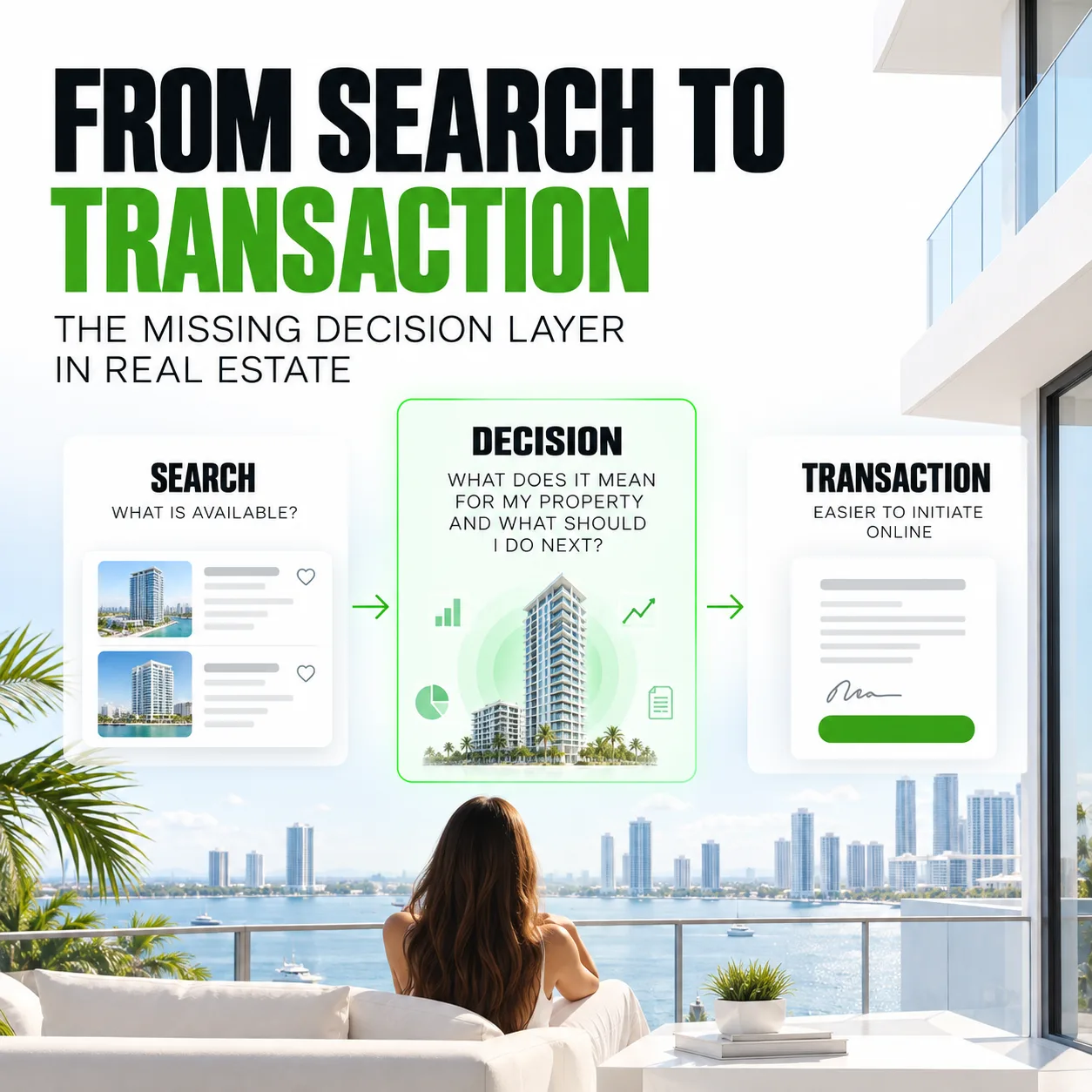

Search made real estate easier to explore. Transactions are becoming easier to initiate online. But between finding information and taking action, homeowners still face the hardest question: what does all of this mean for my property and what should I do next?
For more than two decades, online real estate has been defined by search.
The first major breakthrough was simple but transformative: put listings online. Give consumers access to inventory that once lived primarily inside professional systems. Over time, search became faster, more visual and more sophisticated. Consumers can now browse thousands of properties, see price histories, explore maps, calculate payments, estimate home values, schedule tours and connect with professionals from a phone.
More recently, the transaction itself has also begun moving online. Consumers can request offers, initiate listings, submit purchase terms and move through portions of a transaction digitally.
That progress matters.
But it leaves a surprisingly large gap between search and transaction.
The missing layer is the decision.
Search answers what is available
A search engine or real-estate portal is exceptionally good at answering questions such as:
What is for sale?
What sold nearby?
What homes fit my price range?
What properties are available in this ZIP code?
Those are discovery questions.
For a homeowner or prospective seller, however, the questions quickly become more specific.
What market does my property actually compete in?
Which recent sales are genuinely relevant to my home?
What can a buyer choose instead of my property today?
Is inventory increasing or shrinking?
Are similar properties moving quickly or sitting?
Where does my property appear to stand before I decide on an asking price?
Should I sell now, monitor the market or wait?
Those are decision questions.
And they require more than access to data.
They require context.
Homeowners begin making decisions long before they list
The seller journey does not begin when a listing agreement is signed.
Zillow's 2025 Consumer Housing Trends Report found that the typical seller spent approximately three to four months seriously considering selling before actually listing, while 27% considered the decision for six months or longer. The same research found that maximizing profit was the top priority for 58% of sellers, followed by selling within their desired timeframe for 33%.
That period before the listing is important.
A homeowner may not yet be looking for an agent. They may not even be certain they want to sell.
They are trying to understand.
That is the moment when another list of nearby properties or a single automated number may not be enough.
The homeowner needs orientation.
Before the number, there is the market
One of the most important questions in residential real estate is also one of the easiest to overlook:
What is the relevant market for this property?
Professional valuation guidance recognizes this distinction. Fannie Mae defines a property's market area as the geographic area from which most demand comes and where most of the property's competition is located. Its guidance also says comparable sales within the same market area, including the same subdivision or project, should be used when possible.
That is different from simply asking what sold within an arbitrary radius.
Two homes can be geographically close and still compete differently.
This becomes especially obvious in dense and vertical markets.
Two condominium units may be separated by only a few feet while differing in line, floor, exposure, view, layout or buyer appeal. Two neighboring residential communities may have different ownership costs, amenities, housing types, price positioning or competitive sets.
Nearby is not automatically the same as relevant.
That is why the market itself should come before the number.
The residential market already has an identity
Subdivisions.com approaches this problem differently.
We are not asking each homeowner to define a market around their property.
We have been doing that structural work in advance.
The platform organizes residential real estate around named residential communities—condominium buildings and complexes, subdivisions, townhome communities, gated communities and other defined residential markets.
A homeowner simply finds the property or community they already belong to.
Today, Subdivisions.com has structured 27,000+ residential communities and growing, creating a market layer that can connect properties with the residential context around them.
You can begin by exploring Subdivisions.com or go directly to the Owner & Seller experience.
Closed sales tell us what happened. Active Competition tells us what buyers see now
Traditional comparable analysis naturally gives significant attention to closed sales.
That evidence matters. A closed transaction shows where a buyer and seller actually reached an agreement.
But a homeowner preparing to sell is not competing only with history.
They are competing with the properties a buyer can choose today.
That is why we treat Active Competition as a separate and important layer of market intelligence.
Imagine that a comparable property closed several months ago at $900,000.
Useful information.
But now imagine that three similar properties are currently available at $925,000, $949,000 and $975,000, while one has already reduced its asking price.
The seller now has something much more actionable than a historical comp.
They have context around the choices facing the same buyer.
The Owner & Seller experience on Subdivisions.com brings current competition together with recent closings and community context before a homeowner goes to market.
True Apples-to-Apples starts with relevance
The objective is not to produce the longest list of nearby transactions.
It is to identify the evidence that deserves the most weight.
For a high-rise property, that can mean considering building, stack or line, floor, view, exposure, size and layout.
For another residential community, the relevant attributes may be different.
Our True Apples-to-Apples™ Home Value experience is built around this principle: start with the subdivision or residential community, then narrow the comparison toward the property itself.
The result is presented as a value range supported by market evidence rather than as an appraisal or a promise of a single exact value.
That distinction matters.
Real estate decisions deserve context, not false precision.
The next evolution of real estate is already moving beyond search
The broader industry is beginning to move in the same direction.
In 2026, Zillow introduced an AI experience designed to help consumers move beyond filtering listings toward asking questions, comparing options and taking real-world actions. Zillow itself describes the direction as connecting more of the housing journey through guided intelligence.
Realtor.com has introduced its Market Clock to translate multiple housing indicators into a simpler view of whether market conditions favor buyers or sellers. The tool currently tracks large metropolitan markets and reflects a wider industry effort to turn abundant housing data into understandable decision signals.
This is an important shift.
Search is becoming table stakes.
The next competitive question is not simply who can show more information.
It is who can make that information more relevant to a particular decision.
AI can explain the answer. Context determines whether the answer matters
Artificial intelligence will make real-estate interfaces increasingly conversational.
That will make searching, summarizing and asking questions easier.
But an AI explanation is only as useful as the context underneath it.
If the wrong properties are being compared, a more eloquent explanation does not solve the underlying problem.
This is why we believe the durable layer is the structured residential market itself.
The interface may change.
The questions may be asked through search today and conversation tomorrow.
But the underlying work remains:
Which community does this property belong to? Which evidence is relevant? What is competing now? How is that market changing? Where does the property stand?
AI can help interpret those answers.
The structured market context makes them useful.
From search to decision to action
This is where the idea of a Home Decision Platform becomes more than positioning language.
The journey is not supposed to stop with market research.
It should move naturally from understanding into action:
Search → Choose Your Market → Understand → Compare → Monitor → Decide → List Your Property / Make an Offer → Transaction
That is the layer Subdivisions.com is building between discovery and the transaction.
For sellers, the journey can move from community intelligence and pre-pricing context into a listing and pricing conversation.
For buyers, an active property page can move from research directly into Make an Offer, where proposed terms can begin the professional offer process. Subdivisions.com property pages already integrate this action alongside the property research experience.
For homeowners who are not ready to transact at all, the platform can remain useful by helping them monitor what is changing around the property they already own.
The transaction is an outcome.
The relationship can begin much earlier.
The missing layer between search and transaction
There are already many excellent real-estate search products.
There are automated home-value tools.
There are professional CMAs.
There are online listing solutions and digital offer workflows.
We are not trying to recreate all of those categories under another logo.
The opportunity we see sits between them.
Homeowner Decision Intelligence
Market intelligence is the input.
Decision intelligence is the outcome.
The homeowner should be able to understand the residential market their property belongs to, see the evidence that matters, understand what buyers can choose today, watch meaningful changes and decide what to do next.
That is the missing layer we have been building.
Not another place to simply search.
A place to understand before you act.
Start with your market
Explore Subdivisions.com to find your residential community or property.
Thinking about selling? Start with the Owner & Seller market experience and see the evidence around your property before you price.
Want deeper property-level context? Explore the True Apples-to-Apples™ Value Range.
For ongoing community intelligence and monitoring, review the available Subdivisions.com market-intelligence plans.
Understand first. Act when you're ready.

Comments