
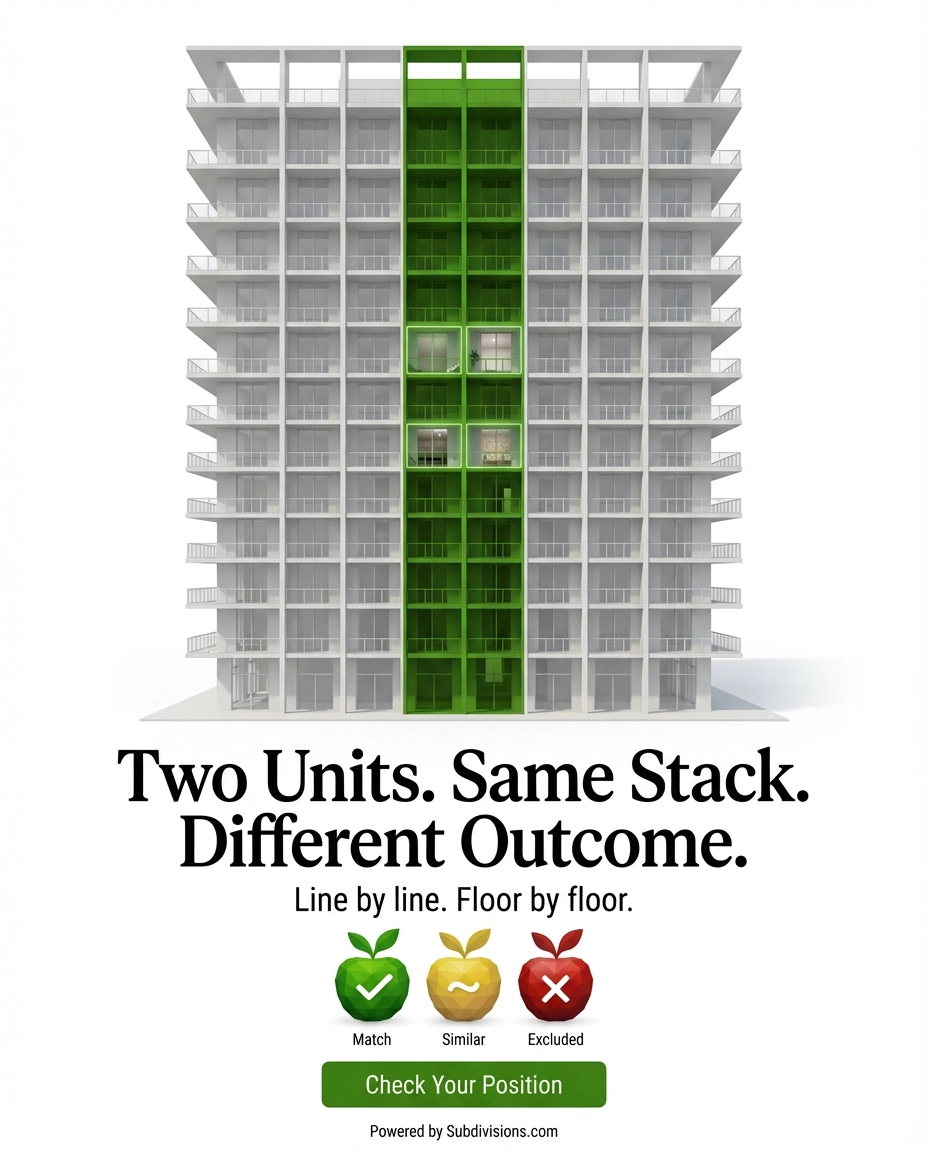

Why High-Rise Residential Assets Require a Different Data Structure
Institutional participation in residential real estate has expanded steadily over the last decade. Developers, private equity groups, lenders, servicers, and portfolio managers increasingly operate inside high-density condominium markets.
At scale, residential real estate stops being transactional.
It becomes operational.
And operational real estate exposes structural weaknesses in how pricing data is organized.
The Structural Gap in High-Rise Pricing Workflows
Most residential pricing workflows were designed for horizontal markets:
• Subdivisions
• Single-family neighborhoods
• Broad geographic zones
• Median-based comparisons
High-rise condominium assets behave differently.
They are vertical markets.
Within a single tower:
• Stack alignment matters
• Floor elevation influences demand
• Exposure orientation affects absorption
• Active competition inside the same line changes velocity
• Pricing distribution within the building is rarely uniform
Yet conventional workflows typically aggregate at the building level — not the stack level.
This creates friction in pricing discipline.
Where Friction Appears in Institutional Contexts
For institutional asset holders and valuation teams, friction is rarely dramatic.
It shows up incrementally:
• Inconsistent comp selection across analysts
• Subjective floor adjustments
• Repricing cycles after extended days on market
• Misalignment between active and sold competition
• Portfolio-level pricing drift
Individually, these are manageable.
Across multiple units and buildings, they compound.
A 3–5% positioning variance on a $1.5M condo represents $45,000–$75,000.
Across 20 units, that becomes $900,000–$1.5M in capital exposure.
Not necessarily as a loss — but as misalignment, delay, and capital inefficiency.
The Limitations of Conventional Data Organization
Traditional tools emphasize:
• Size
• Sale date
• Building name
• Geographic filter
They do not consistently isolate:
• Vertical stack behavior
• Intra-building pricing distribution
• Stack-specific velocity
• Active vs sold alignment within identical lines
This isn’t a failure of expertise.
It is a structural limitation of how residential data is organized.
High-rise assets require a different organizing principle.
What Enterprise Micro-Market Intelligence Access Means
Enterprise micro-market intelligence access refers to structured, building-level data organized around how pricing actually competes in high-rise environments.
At the core, it means:
• Vertical stack isolation
• Line-by-line comp organization
• Floor-tier clustering
• Active vs sold normalization
• Distribution visibility inside a single tower
It does not replace licensed appraisal methodology.
It does not produce valuation conclusions.
It supports pricing workflows by reducing comp selection noise and increasing structural consistency.
Where This Matters Most
Institutional Condo Inventory Holders
Managing multiple units within the same tower requires stack-level alignment to avoid internal competition and pricing distortion.
Developers Managing Remaining Inventory
Release schedules and tiered pricing require clarity on floor-level performance.
Portfolio Managers
Reducing incremental variance across units improves exit modeling and capital planning.
BPO & Valuation Oversight Teams
Standardized stack-aware comp review improves defensibility and consistency.
Decision Support, Not Valuation Replacement
Enterprise micro-market intelligence is not an AVM.
An AVM attempts to predict value.
Micro-market intelligence structures context.
One generates numbers.
The other organizes competition.
In high-rise markets, context organization often reduces pricing drift more effectively than abstract predictive modeling.
Subdivisions.com: A Structured Infrastructure Layer
Subdivisions.com was designed around subdivision and building-level data organization.
In high-rise markets, it structures pricing information vertically:
• Line-by-line
• Floor-by-floor
• Active and sold alignment
• Intra-building distribution
The objective is straightforward:
Improve pricing workflow discipline in dense vertical markets.
Not through automation of conclusions — but through structured context.
Why This Matters Now
High-rise residential markets are increasingly capital-intensive.
Holding costs, absorption rates, and portfolio timing directly impact return profiles.
When pricing precision improves:
• Repricing cycles reduce
• Internal review time shortens
• Portfolio noise decreases
• Capital deployment becomes more predictable
Small structural improvements in pricing workflow produce measurable operational stability at scale.
The Direction of Residential Asset Intelligence
As residential markets mature and institutional participation grows, horizontal data aggregation becomes less sufficient.
Vertical structure becomes more relevant.
Enterprise micro-market intelligence access represents a shift:
From generalized market visibility
To structured asset-level context
Subdivisions.com operates at that layer — organizing data inside the building where high-rise pricing behavior actually lives.
Not as a marketing platform.
Not as a replacement for professional judgment.
But as infrastructure for residential asset decision-making.

Comments