

A Founder’s Perspective on the Evolution of Real Estate Data
By Jake Miakota
Subdivisions.com didn’t start as a startup idea.
It started with a question.
In 2005, while researching where to relocate, I spent a considerable amount of time studying the Miami real estate market. With a background in web development and building data-driven systems, I approached the process analytically. I wasn’t just browsing listings — I was trying to understand how the market itself worked.
Like many people who have bought or sold property before, I already understood an important reality of real estate: property values are rarely determined at the city or ZIP code level. Instead, value is formed within much smaller competitive environments — specific communities, subdivisions, and condominium buildings.
But when I began researching the South Florida market online, the way real estate was presented digitally didn’t reflect that reality.
Listings showed what was available. They rarely explained how homes actually competed within the communities where they were located.
That gap between market reality and data representation became the starting point for a journey that would eventually lead to Subdivisions.com.
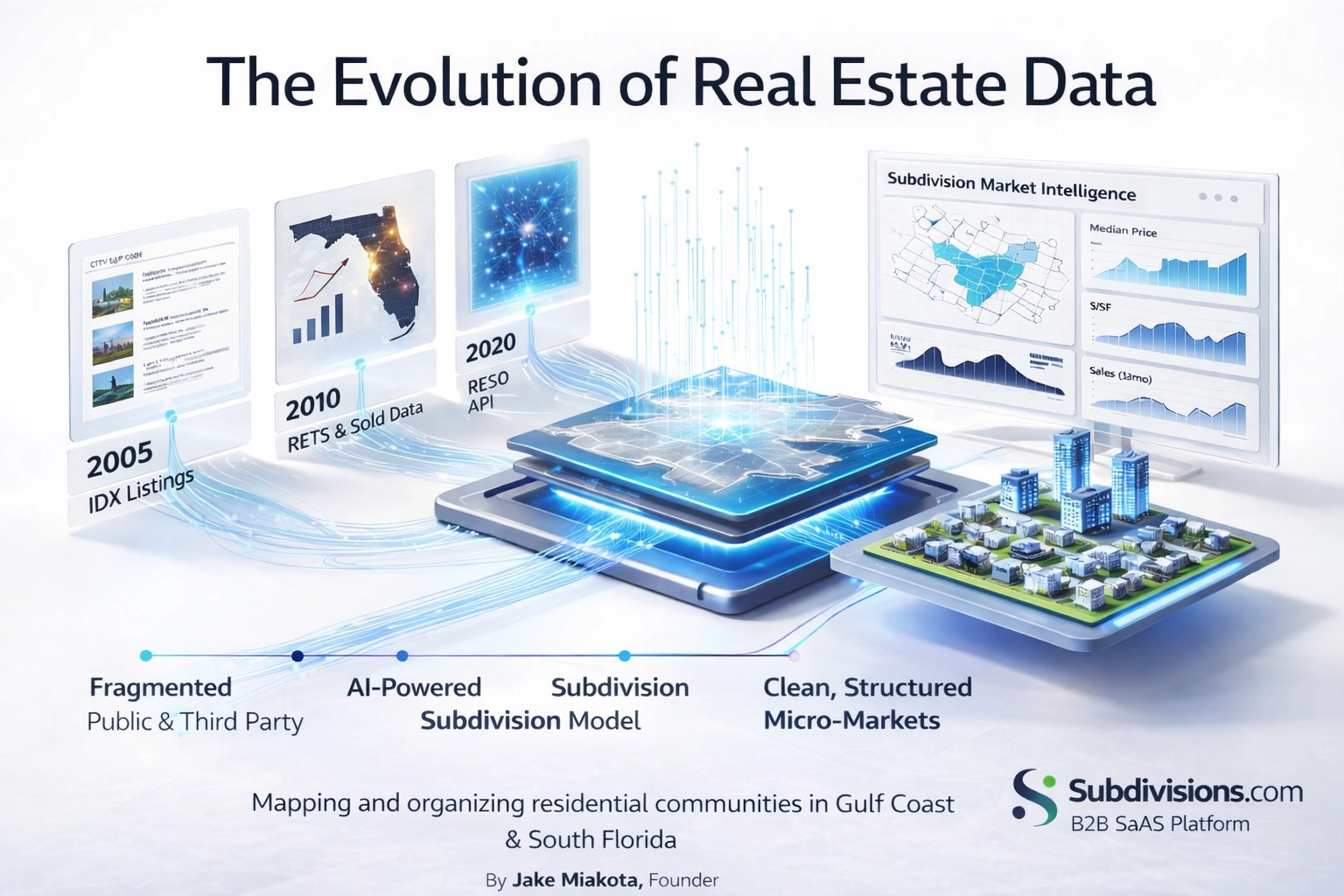
Real Estate Search in the Early Internet Era
In the early 2000s, real estate search looked very different from what consumers experience today.
Zillow had not yet launched publicly (its website debuted in 2006), and although Realtor.com existed, national portals were not the dominant tools for home search in many local markets.
In places like South Florida, property discovery was largely driven by local brokerage websites powered by early IDX feeds from the MLS.
IDX — or Internet Data Exchange — was a major milestone in the industry. Approved by the National Association of Realtors around 2000, IDX allowed brokerages to display listings from other brokers on their own websites. For the first time, consumers could search available homes online rather than relying entirely on agents for property discovery.
But the systems themselves were still relatively basic. Most websites organized listings around cities or ZIP codes, which made broad searching possible but did little to reflect how real estate markets actually function.
Anyone who works in real estate understands that homes don’t compete across an entire city.
They compete within communities, subdivisions, and buildings — the micro-markets where buyers evaluate comparable properties.
Yet those community structures were largely missing from early online search experiences.
Building the First Platform
After moving to Miami, the first project wasn’t a brokerage.
It was a website.
With a background in web development, the instinct was to address the navigation problem through technology. The goal was to create a real estate search experience that organized listings around the communities people actually recognized.
Using IDX data, we built a platform that grouped listings by subdivisions and residential communities, making it easier for users to narrow their search and explore specific areas.
Over time, that platform gained traction and eventually evolved into a full-service brokerage known as Best of Luxury Realty.
But even with improved search navigation, an important layer of insight was still missing.
Listings showed what properties were currently available — but they didn’t provide deeper market context.
Introducing Community-Level Market Context
To address that gap, we began attaching county sales records to individual subdivisions.
This allowed users to view historical sales activity within specific communities rather than seeing listings in isolation. By organizing public sales data around subdivisions, users could begin to understand how properties had traded over time within a particular community.
At the time, this kind of information was rarely available on consumer-facing real estate websites. Most sold data was accessible primarily through MLS systems and available only to licensed real estate professionals.
Connecting historical sales data to subdivision pages helped provide something most platforms lacked:
context.
For buyers and sellers trying to understand a market, context is often more valuable than listings alone.
When More Data Became Available — But Still Fragmented
As the industry evolved, the technology used to distribute real estate data also improved.
One of the most important developments was the introduction of RETS (Real Estate Transaction Standard), which provided a more structured way for MLS systems to deliver data to brokerage websites. RETS was particularly significant because it expanded access to MLS sold data, enabling deeper analysis of local market activity.
But even with access to more data, the underlying problem remained.
The data itself was often fragmented and inconsistent.
Subdivision names were rarely standardized. The same community could appear under multiple variations. Listings were frequently associated with inconsistent location identifiers, making it difficult to determine which community a property truly belonged to.
In other words, the industry had gained more data — but the data still lacked structure.
Solving that problem required more than displaying listings.
It required structuring the data itself — algorithmically mapping properties to their relevant communities and curating how subdivisions were represented across the dataset.
More recently, the industry has moved toward RESO Web API, a modern standard designed to deliver faster and more consistent MLS data access.
But regardless of how data is delivered, the fundamental challenge remains the same:
raw listing data alone does not explain how local real estate markets function.
National Platforms and the Scale Challenge
Over time, national real estate platforms such as Zillow and Realtor.com grew rapidly and transformed how consumers access housing inventory.
Their platforms were designed for national reach and scale, aggregating listings across thousands of markets.
That approach brought enormous visibility to housing data and made property search far more accessible to consumers.
But scale introduces its own trade-offs.
Large platforms must build systems that work consistently across every market in the country. As a result, most national search tools focus primarily on listing discovery, rather than deeply structuring how individual local markets operate.
Real estate markets, however, are inherently local.
Pricing dynamics are shaped within specific communities, subdivisions, and buildings — the micro-markets where buyers compare similar properties.
Understanding those competitive environments requires a level of data organization that goes beyond simply displaying listings.
Rethinking the Structure of Real Estate Data
When development began on Subdivisions.com, the goal was to rethink how real estate markets should be organized digitally.
Rather than relying on fragmented location labels, the mission was to identify and map the most active residential communities across South Florida and the Gulf Coast and organize listings around those communities as clearly defined market units.
In practical terms, that meant building a structured dataset capable of mapping properties to their relevant subdivisions or residential communities whenever possible.
This approach required extensive data normalization, algorithmic mapping, and ongoing curation.
The objective was simple:
make subdivisions the single source of truth for understanding residential micro-markets.
From Local Research to Data Infrastructure
Subdivisions.com represents the third major iteration of this concept.
The platform took four years to develop and focuses on building a structured dataset that organizes real estate around subdivisions, communities, and residential buildings.
Today, Subdivisions.com operates as a B2C2B SaaS platform designed to provide structured micro-market intelligence for the real estate industry.
Rather than functioning as another national listing portal, the platform focuses on delivering data infrastructure that helps professionals — and ultimately consumers — better understand how homes compete within specific communities.
By organizing real estate data around subdivisions and residential developments, the platform enables deeper market analysis, clearer comparisons, and more informed decision-making.
Building the Map of Residential Communities
At its core, the mission behind Subdivisions.com is to map and organize residential communities in a way that reflects how housing markets actually function.
The initial focus has been on South Florida and the Gulf Coast, two regions with complex housing markets and diverse residential communities.
By mapping subdivisions and organizing market activity around them, the goal is to provide home shoppers and homeowners with better tools for search, discovery, and market intelligence.
When buyers and sellers can clearly understand how properties compete within a community, they can approach real estate decisions with greater clarity and confidence.
South Florida and the Gulf Coast represent the first phase of that effort.
The broader vision is to bring structured community-level intelligence to residential markets more broadly.
A Twenty-Year Journey
Although Subdivisions.com officially launched in 2024, the ideas behind it began more than two decades earlier.
What started as a personal effort to better understand the structure of a real estate market gradually evolved into a long-term project focused on organizing real estate data around the communities where homes actually compete.
Real estate markets are inherently local.
And understanding them often begins with the places people recognize most clearly — the communities where they live, invest, and build their lives.
Subdivisions.com was built around that simple observation.

Comments